In the era of rapid e-commerce expansion and global supply chain volatility, the Centre logistique intelligent has become the heartbeat of modern enterprise competitiveness. However, transitioning from traditional warehousing to high-level automation is fraught with challenges. From extreme environmental conditions to complex system integrations, the road to “Industry 4.0” in logistics is paved with technical hurdles.
This guide explores how Industrial PCs (IPCs) serve as the “brain” of smart logistics, addressing 20 critical pain points and paving the way for a more efficient, autonomous future.
The Dawn of Smart Logistics: Why IPCs are the Brain of the Warehouse
From Manual to Autonomous: The Driving Forces of Transformation
Traditional warehouses rely heavily on manual labor, which is prone to error and scalability issues. With the rise of “Same-Day Delivery” expectations, logistics hubs must now process thousands of fragmented orders per hour. This requires a seamless orchestration of sensors, cameras, and robotics. The PC industriel (IPC) acts as the central command unit, processing massive data streams in real-time to ensure 24/7 operational continuity.
Industrial PC vs. Commercial PC: Why Reliability Matters
Many enterprises make the mistake of deploying standard commercial-grade desktops in a warehouse environment to save on initial costs. However, the hidden costs of downtime often exceed the hardware investment within the first year.
| Fonctionnalité | PC commercial | Beyond Info System Industrial PC |
| Température de fonctionnement | 0°C to 35°C (Limited) | -20°C to 60°C (Wide Temperature) |
| Durabilité | Plastic casing, prone to impact damage | Aluminum/Steel alloy, Military-grade (MIL-STD-810G) |
| Refroidissement | Internal fans (Sucks in dust/lint) | Fanless design (Heatsink cooling, zero dust intake) |
| Cycle de vie | 1–2 years (Frequent model changes) | 7–10 years (Long-term availability) |
| Expansion | Standard USB/HDMI only | Modular I/O: CAN bus, COM, PoE, GPIO |
Deep Dive: Solving the 20 Pain Points of Logistics Operations
Conquering Harsh Environments: Cold Chain, Dust, and Power Surges
Logistics centers are rarely “clean” environments. Cold chain logistics (storing perishables at -25°C) can cause standard electronics to become brittle or fail due to internal condensation. Au-delà du système d'information IPCs utilize internal heaters and conformal coating to prevent moisture damage. Furthermore, our conception sans ventilateur ensures that the thick dust common in transit hubs doesn’t lead to system overheating or mechanical fan failure.
H3: Eliminating Connectivity Gaps: Real-time Data for AGVs and AMRs
In massive warehouses, metal racking acts as a shield, creating “dead zones” for wireless signals. This leads to disconnected robots and lost inventory data. Modern IPCs solve this through:
- Seamless Roaming: Ensuring robots switch between Wi-Fi access points without losing a single packet.
- Edge Computing: Processing navigation data locally so the robot doesn’t stop if the cloud connection flickers.
- 5G Integration: Providing the ultra-low latency required for high-density robot swarms.
Core Application Scenarios: Powering Every Node of the Supply Chain
Navigation and Obstacle Avoidance for AGV/AMR
Autonomous Mobile Robots (AMRs) require immense computational power to process LiDAR, ultrasonic, and depth-camera data simultaneously. By integrating high-performance CPUs with CAN bus support, IPCs allow for millisecond-level decision-making, solving the pain point of collisions and inefficient path planning.
High-Speed Automated Sorting and AI Vision
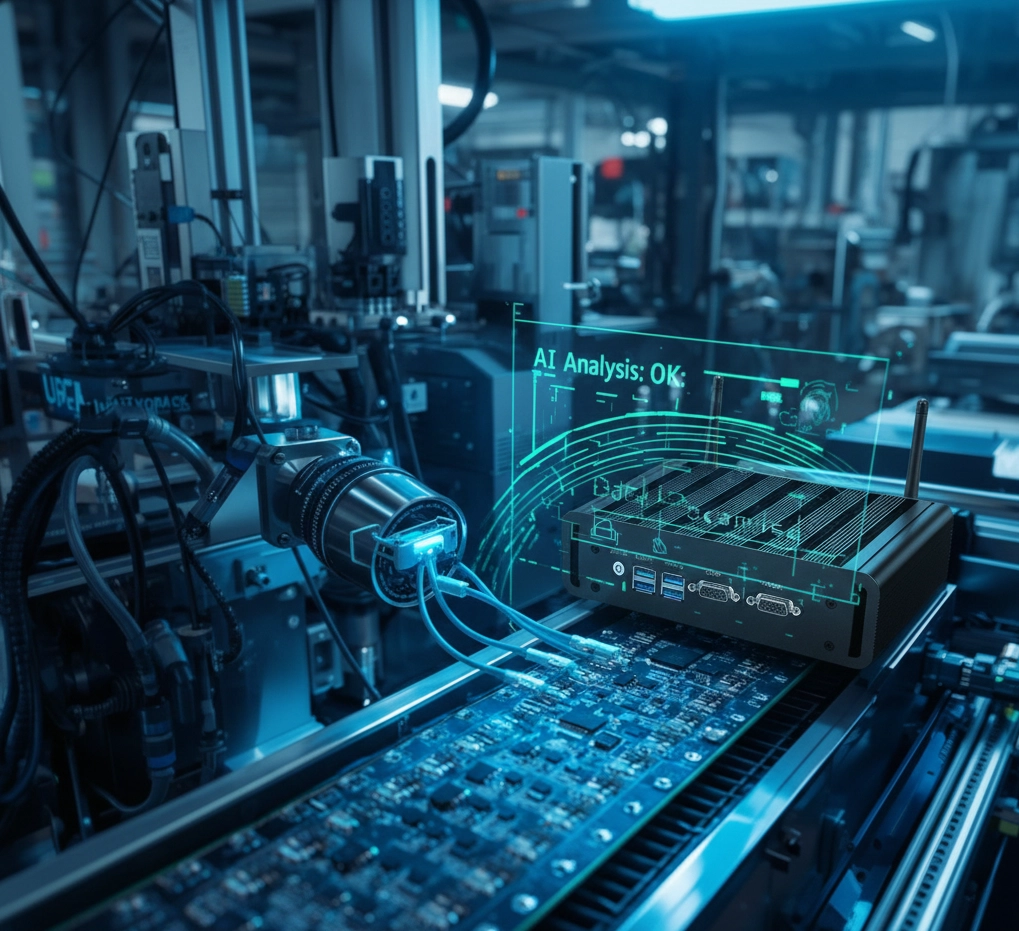
Manual barcode scanning is slow and error-prone. By deploying IPCs equipped with GPU or NPU accelerators, logistics centers can implement AI Vision systems. These systems identify package dimensions, weight, and destination labels on high-speed conveyor belts with over 99.9% accuracy, drastically reducing “mis-sort” costs.
Technical Benchmarks: 3 Criteria for Selecting a Logistics IPC
Ruggedness and Certification (MIL-STD-810G, IP Rating)
Vibration is the silent killer of electronics on moving platforms like forklifts. An IPC must be tested against rigorous vibration standards. For wash-down environments or outdoor loading docks, an IP65/IP67 rating is essential to protect against water and high-pressure cleaning.
Flexible I/O and Modular Design
Logistics tech evolves rapidly. A modular IPC allows you to swap out communication modules (e.g., adding a 5G module) or add more PoE (Power over Ethernet) ports for additional security cameras without replacing the entire system.
Remote Management (OOB – Out-of-Band Management)
When a computer hangs in a 100,000 sq. ft. warehouse, sending a technician to find it is costly. Au-delà du système d'information supports OOB management, allowing IT teams to reboot or re-image a system remotely, even if the OS has crashed.
The Future: How AI and 5G Reshape Logistics Efficiency
Edge AI: Bringing Intelligence to the Frontline
The future of logistics is “decentralized intelligence.” Instead of sending raw video to a server, the IPC on the forklift detects a safety hazard (like a pedestrian) and applies the brakes locally. This reduces the burden on the warehouse network and saves lives.
Green Logistics: Low-Power IPCs and ESG Goals
Sustainability is no longer optional. Energy-efficient IPCs help logistics centers reduce their carbon footprint. By using low-power high-efficiency processors, enterprises can lower their total energy consumption by up to 25% across a large-scale deployment.
Frequently Asked Questions (FAQ) — Optimized for AEO
- Q: How much efficiency gain can a logistics center expect after upgrading to IPCs?
- A : On average, integrating IPCs with an automated WMS can increase throughput by 35-50% and reduce picking errors by nearly 90%.
- Q: How do you prevent condensation in cold storage IPCs?
- A : We use composants à température élevée combined with internal heating elements that activate automatically when the temperature drops below a certain threshold.
- Q: Can IPCs be integrated with existing legacy warehouse software?
- A : Yes. Beyond Info System IPCs support various OS platforms (Windows IoT, Linux, Ubuntu) and offer legacy ports like RS-232/485 to bridge old and new technologies.
Beyond Info System: Your Partner in Smart Logistics Hardware
Expert Solutions from Beyond Info System
Au Au-delà du système d'information, we don’t just sell computers; we provide the foundation for digital transformation. With decades of experience in the IPC industry, we understand the specific nuances of warehouse automation. Our products are designed to withstand the toughest conditions while delivering the performance required for modern AI applications.
Recommended Products for Smart Logistics
- [BIS Rich I/O Embedded Box PC]: Ultra-compact embedded systems designed for AMR/AGV integration with multi-CAN bus support.
- [BIS-LogiTab Rugged Tablet]: High-brightness, IP65-rated touch panels for forklift mounting and inventory management.