Introduction: Why Chassis Material Defines the Lifespan of your Panel PC
In the world of Industrial IoT (IIoT) and Smart Manufacturing, an Industrial Panel PC is more than just a computer with a touch screen; it is the critical interface between human intelligence and machine precision. For European OEMs and System Integrators, selecting the right chassis material is not a matter of aesthetics—it is a strategic engineering decision that dictates the system’s Total Cost of Ownership (TCO).
The Harsh Reality of Industrial Environments
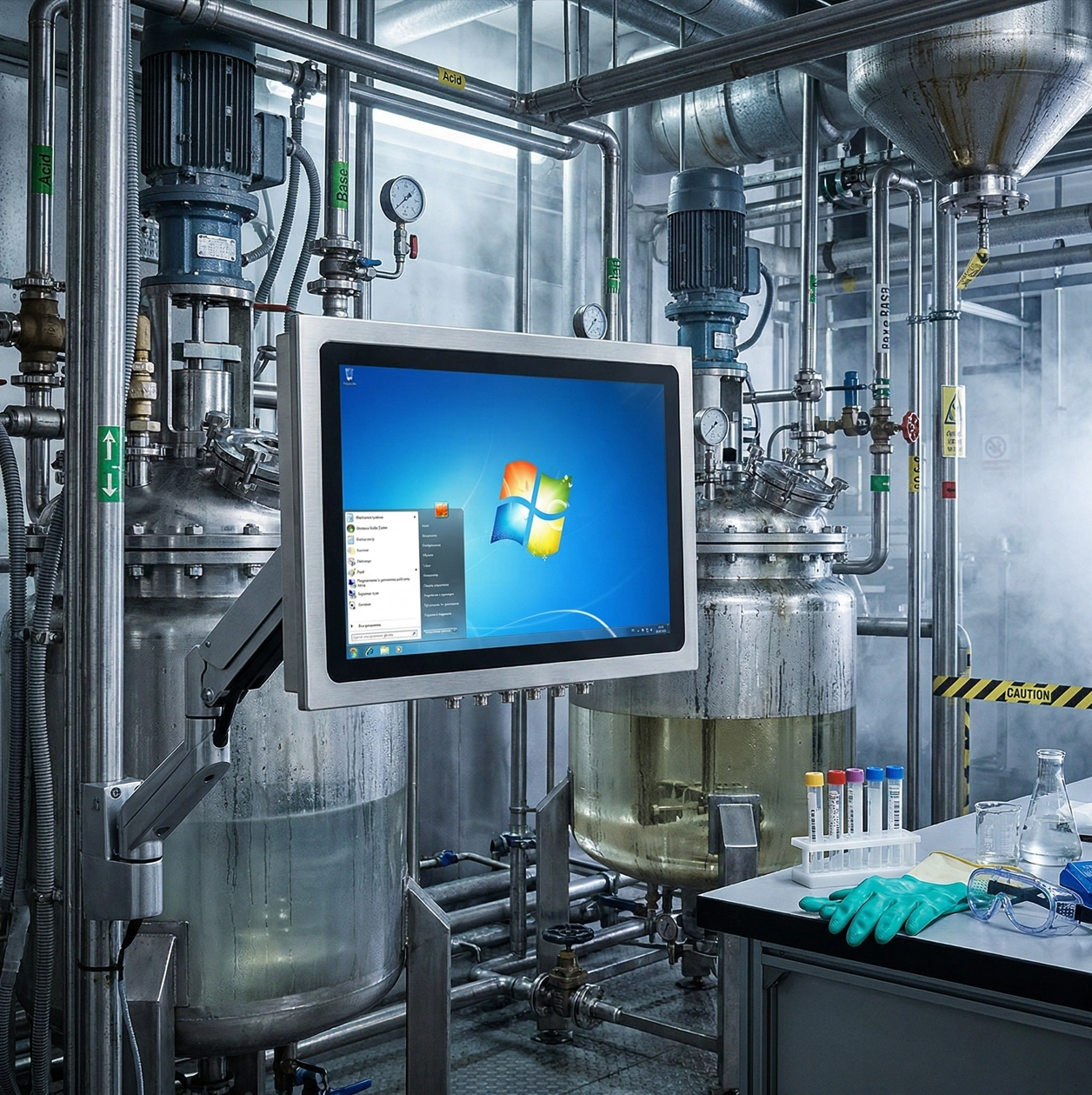
Industrial deployments are unforgiving. Unlike commercial-grade tablets, an Industrial Panel PC must survive constant mechanical vibrations, extreme temperature fluctuations (from frozen food lockers to hot steel mills), and exposure to corrosive cleaning agents. Whether it is a CNC control room in Germany or a salmon processing plant in Norway, the chassis serves as the first and most vital line of defense.
The Dual Role of the Chassis: Protection and Thermal Regulation
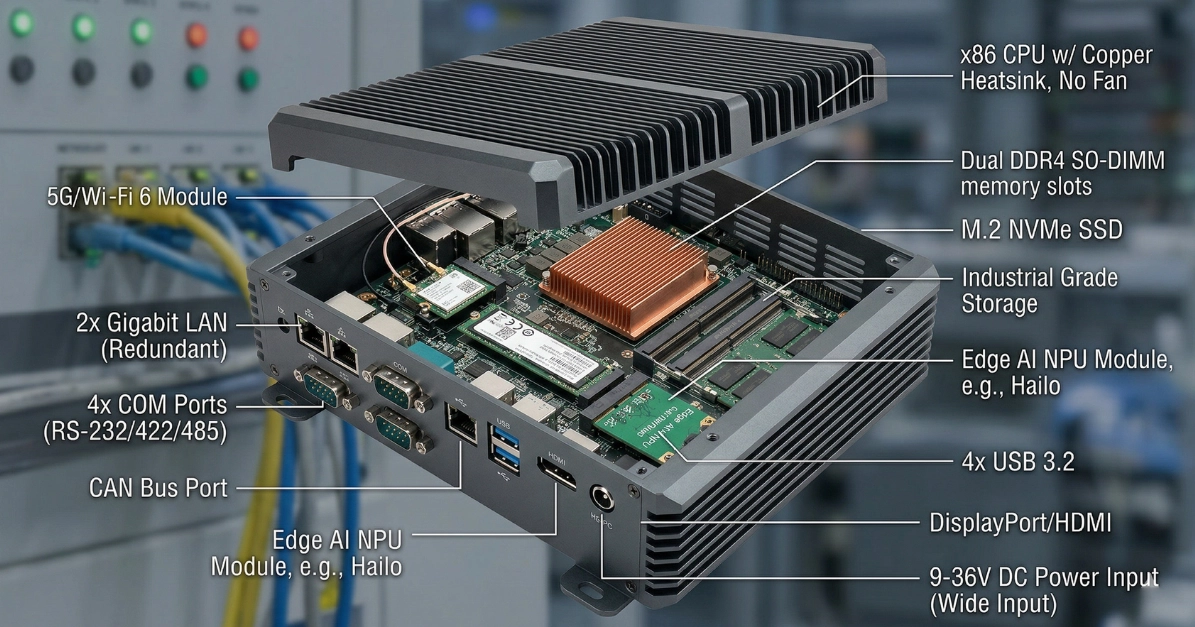
In a fanless system, the housing is not just a “box”—it is a sophisticated heat sink. Choosing between Aluminum Die-casting and Stainless Steel requires a balance of thermal conductivity, chemical resistance, and structural integrity. This guide explores the engineering nuances of both materials to help you make an informed choice for your next project.
Aluminum Die-Casting: The Champion of Thermal Management and Lightweight Versatility
Aluminum is the backbone of the modern Industrial PC (IPC) industry. Known for its excellent strength-to-weight ratio and superior thermal properties, it is the go-to choice for high-performance automation.
Thermal Conductivity: The Heart of Fanless Design
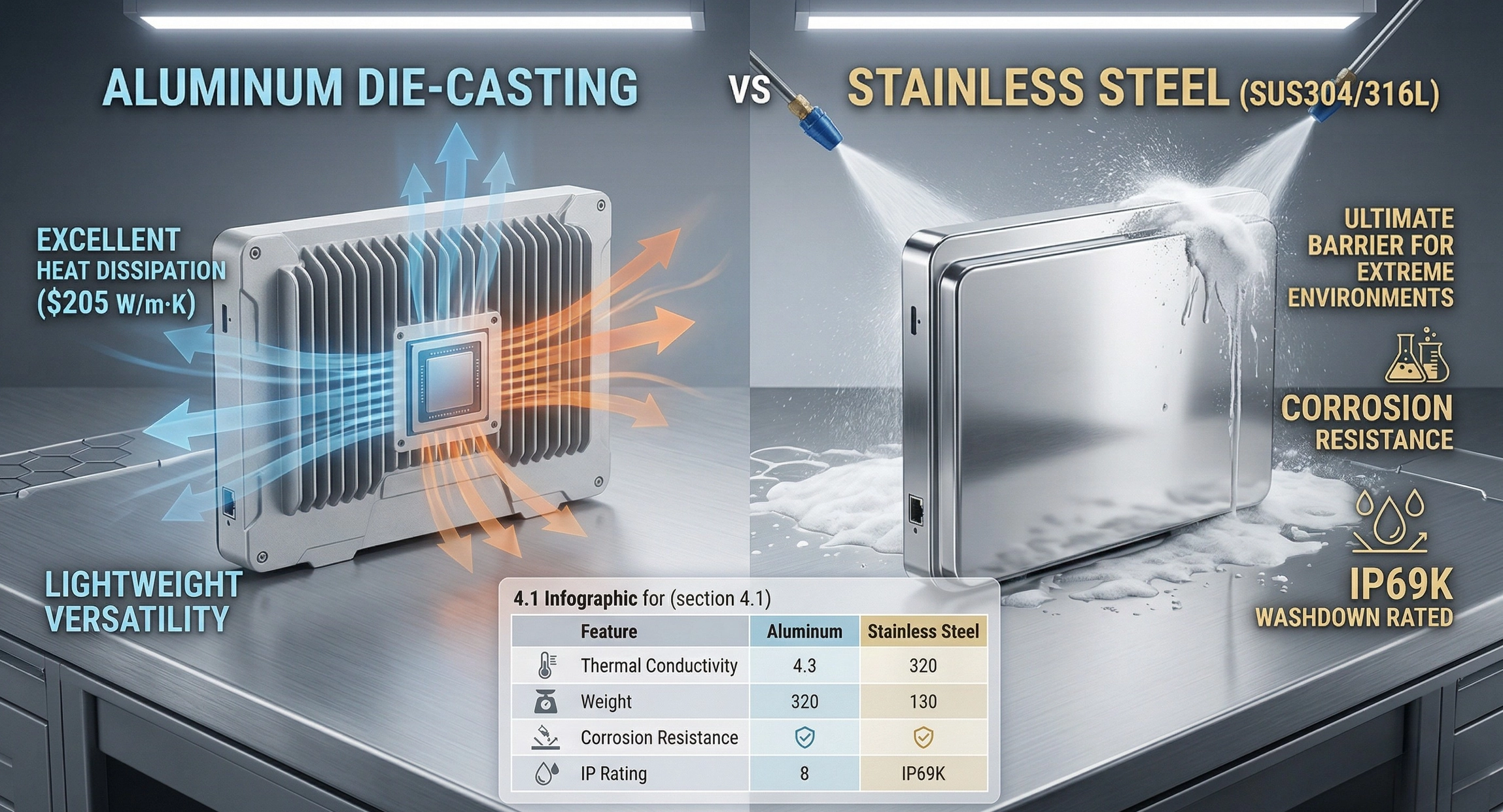
The primary reason engineers prefer aluminum is its thermal conductivity ($k \approx 205 \text{ W/m·K}$). In a fanless Panel PC, heat must be moved away from the CPU and internal components via conduction to the outer shell, where it is dissipated through natural convection.
- Efficient Heat Dissipation: Aluminum transfers heat nearly four times faster than carbon steel and over twelve times faster than stainless steel.
- Eliminating Hot Spots: Its high conductivity ensures that heat is distributed evenly across the entire surface of the chassis, preventing localized overheating that can lead to system throttling or component failure.
The Precision of the Die-Casting Process
Beyond Info System utilizes advanced die-casting techniques where molten aluminum is injected into precision-engineered molds under high pressure.
- Integrated Heat Fins: We can cast complex, high-density cooling fins directly onto the rear chassis. This increases the surface area for cooling without adding the bulk of a separate heat sink.
- Structural Uniformity: Die-casting creates a unibody-like structure that is incredibly rigid. This minimizes the number of seams and joints, which is essential for maintaining long-term IP65 sealing against dust and moisture.
- Blindage EMI : Aluminum inherently provides excellent Electromagnetic Interference (EMI) shielding, protecting sensitive internal electronics from the “noise” of nearby high-voltage industrial machinery.
Economic Efficiency for OEM Scalability
For European OEMs looking to scale their solutions, aluminum die-casting offers significant advantages:
- Production Speed: Once the mold is created, the cycle time for die-casting is significantly faster than CNC machining, allowing for consistent quality in high-volume production.
- Lightweight Logistics: Aluminum is approximately one-third the weight of stainless steel. This reduces shipping costs to Europe and makes the units easier to install on swing arms or light-duty pedestals.
Stainless Steel: The Ultimate Barrier for Extreme and Sanitary Environments
While aluminum excels in heat dissipation, certain industries demand a material that is virtually indestructible and chemically inert. This is where Stainless Steel (specifically SUS304 and SUS316L) becomes the gold standard.
Corrosion Resistance: Meeting the Standards of Food and Pharma
In the Food & Beverage and Pharmaceutical industries, “cleanliness” is regulated by law.
- Chemical Stability: Machines in these sectors are subjected to “Clean-in-Place” (CIP) procedures using aggressive alkaline or acidic sanitizers. Stainless steel forms a self-healing chromium oxide layer that prevents rust and pitting.
- SUS316L for Marine and Medical: Beyond Info System offers 316L grade stainless steel for environments with high salt spray (marine) or high chlorine exposure, providing the highest level of acid and alkali resistance available.
Resilience Against High-Pressure Washdowns (IP69K)
The IP69K rating is the highest protection level on the ingress protection scale. It requires the device to withstand high-pressure ($100 \text{ bar}$), high-temperature ($80^\circ\text{C}$) water jets from multiple angles.
- Non-Porous Surface: Stainless steel is non-porous, meaning bacteria and organic matter cannot penetrate the surface.
- Rugged Durability: The material is incredibly tough. It does not chip, flake, or peel like painted or powder-coated aluminum, ensuring that no foreign particles contaminate a food production line.
Engineering Challenges: Overcoming Low Thermal Conductivity
The trade-off for stainless steel’s durability is its low thermal conductivity ($16 \text{ W/m·K}$). To maintain a fanless design with a stainless steel chassis, Beyond Info System employs specialized thermal engineering:
- Internal Copper Heat Spreaders: We use high-grade copper blocks to “bridge” the heat from the CPU directly to the stainless steel skin.
- Vapor Chambers: In high-performance models, vapor chamber technology is used to move heat rapidly to the largest possible surface area, compensating for the material’s natural resistance to heat flow.
Head-to-Head Comparison: Data-Driven Material Selection
To assist OEM procurement managers, we have summarized the technical differences in the table below:
Technical Specification Comparison
| Fonctionnalité | Aluminum Die-Casting | Stainless Steel (SUS304/316L) |
| Thermal Conductivity | Excellent (205 W/m·K) | Low (16 W/m·K) |
| Weight | Lightweight (approx. $2.7 \text{ g/cm}^3$) | Heavy (approx. $8.0 \text{ g/cm}^3$) |
| Résistance à la corrosion | Moderate (Requires Coating) | Exceptional (Inherent Property) |
| Max Ingress Protection | IP65 / IP66 | IP66 / IP69K |
| Typical IK Rating | IK07 / IK08 | IK09 / IK10 |
| Meilleur pour | General Automation, Logistics, HMI | Food Processing, Pharma, Marine |
| Cost (Raw Material) | Modéré | Haut |
Impact Resistance (IK Rating) and Structural Integrity
The IK rating measures a device’s resistance to kinetic energy impacts.
- Aluminum: Perfectly suitable for most factory floors where accidental bumps might occur.
- Stainless Steel: Rated for IK10 (the highest), these units are effectively “vandal-proof” and can withstand heavy impacts from tools or machinery without compromising the internal electronics.
Strategic Recommendation: Which One Should You Choose?
- Choose Aluminum if your priority is high computing power (Core i5/i7) in a compact, fanless form factor for standard factory automation or smart building controls.
- Choose Stainless Steel if your application involves daily chemical disinfection, exposure to salt air, or if you must comply with strict hygiene standards like those set by the EHEDG or FDA.
Design Details: The Beyond Info System Advantage
A rugged chassis is only as good as its weakest seal. At Beyond Info System, we focus on the intersection of materials science and mechanical design.
True Flat Front Bezel Design
A critical feature for both aluminum and stainless steel models is our “True Flat” design. By eliminating the raised edges found on traditional monitors:
- No Liquid Accumulation: Water and cleaning fluids slide off the surface, preventing the growth of mold or bacteria in crevices.
- Optimized PCAP Touch: Our projected capacitive touch screens are calibrated for industrial use, allowing for seamless operation even when the user is wearing thick nitrile or latex gloves.
Gasket Engineering and Long-term Sealing
The interface between the metal chassis and the glass touch panel is the most vulnerable point for ingress.
- Industrial-Grade Silicone Seals: We use high-resilience silicone gaskets that maintain their shape and sealing properties across a wide temperature range (-20 degrés à 70 degree).
- Uniform Pressure Mounting: Our mounting brackets are designed to apply even pressure across the gasket, ensuring that the IP rating remains intact even after years of vibration.
Foire aux questions (FAQ)
Q1: Can an aluminum chassis achieve a high waterproof rating?
A : Absolutely. While stainless steel is more famous for waterproof applications, Beyond Info’s aluminum series utilizes precision CNC-machined grooves and dual-gasket systems to achieve IP65 and IP66 ratings, which are more than sufficient for most indoor industrial spray-down environments.
Q2: Is SUS316L really necessary, or is SUS304 enough?
A : SUS304 is excellent for general food processing. However, if your facility uses heavy chlorine-based cleaners or is located near the ocean, SUS316L (which contains Molybdenum) is required to prevent “pitting” corrosion over time.
Q3: Does the weight of stainless steel affect mounting options?
A : Yes. Stainless steel units are significantly heavier. When planning your installation, ensure that your VESA arms or cabinet cutouts are rated for the additional weight. Beyond Info provides reinforced mounting plates specifically for our stainless steel series.
À propos de Beyond Info System
Your Partner in European Industrial Computing
Au-delà du système d'information is a premier manufacturer specializing in high-performance Industrial Touch Panel PCs. With over 9 years of experience in the IT and CCTV sectors, we have built our reputation on engineering excellence and a deep understanding of the European OEM market. We don’t just sell hardware; we provide the reliability that allows your software and systems to shine.
Our Featured Product Lines
- Rugged Aluminum Series: Optimized for Edge AI and Smart Factory HMI, featuring superior heat dissipation and fanless reliability.
- Full Stainless IP69K Series: The ultimate sanitary solution for Food, Beverage, and Chemical industries, designed to withstand the most aggressive cleaning regimes.
- Services OEM/ODM sur mesure : We offer “White Label” services, custom I/O configurations, and branding options tailored for European system integrators. Our multilingual team (English, Spanish, Mandarin) ensures seamless communication and technical support.
Explore our full technical specifications, nous contacter.