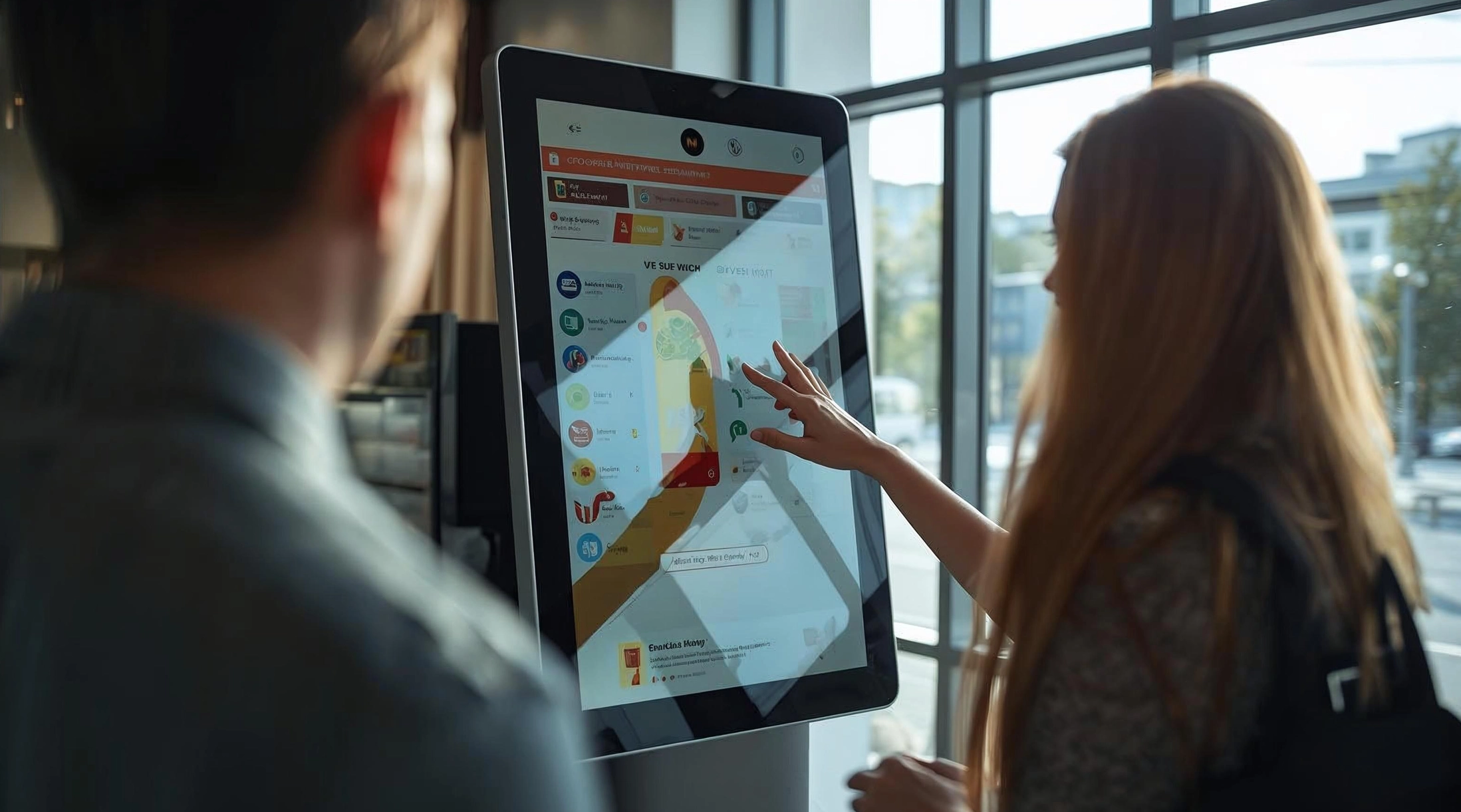
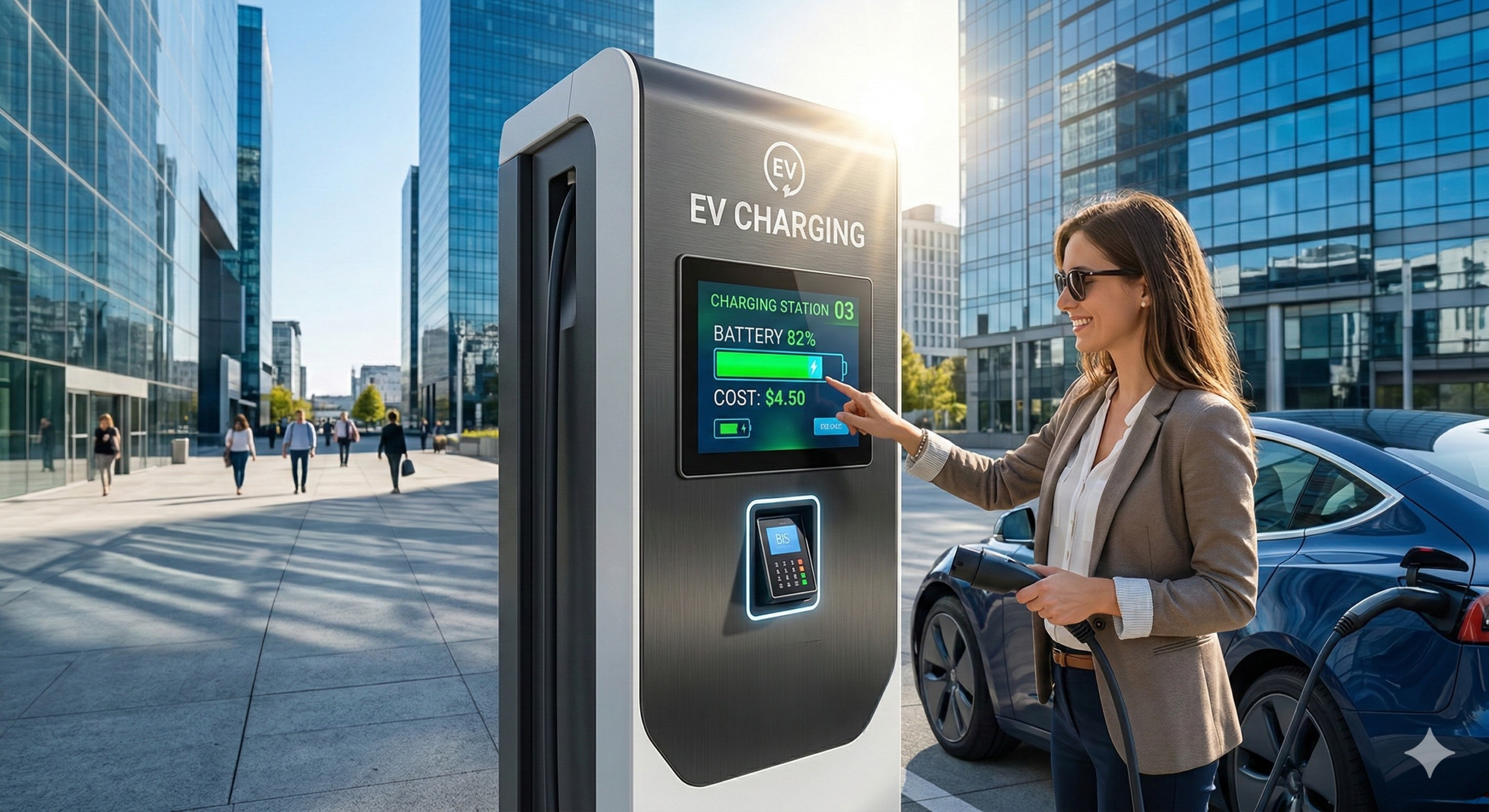
In the era of Smart Cities and Industrial IoT (IIoT), the deployment of outdoor interactive terminals—ranging from EV charging stations and parking payment machines to digital wayfinding kiosks—has surged. However, a persistent challenge plagues these deployments: poor sunlight readability. When a standard display is placed under direct sunlight, it often becomes a “dark mirror,” rendering the user interface invisible and the machine useless.
As a professional editor at Oltre il sistema informativo (BIS), I will guide you through the physics of display interference, the evolution of high-brightness technology, and why Control Panel PCs are the backbone of modern outdoor automation.
The Invisible Killer of Outdoor Terminals: Why Screens Go “Black” in the Sun
The Physics of Reflection: Specular vs. Diffuse Interference
The primary reason a screen becomes unreadable outdoors is not just “low light,” but the overwhelming presence of ambient light. When sunlight hits a display surface, two types of reflection occur:
- Specular Reflection: The glass surface acts like a mirror, reflecting the sky or the user back at themselves.
- Diffuse Reflection: Light penetrates the outer glass, hits the internal air gaps between the touch sensor and the LCD, and scatters. This “washes out” the colors, turning deep blacks into a hazy grey.
Without specialized treatment, the ambient light reflected off the screen can reach over 500 nits, which easily overpowers a standard 300-nit office monitor.
The Business Impact: How Poor Readability Destroys ROI
For a business operator, a screen that cannot be read is a failed investment.
- User Frustration: If an EV driver cannot read the charging instructions at noon, they will seek another station, leading to direct revenue loss.
- Safety Hazards: In industrial or transportation hubs, failing to read a critical warning message on a Control Panel PC can lead to operational errors.
- Brand Perception: Faded, unreadable screens suggest that the service provider uses “cheap” or “consumer-grade” hardware, damaging the perceived reliability of the brand.
Decoding the “Nit”: What Truly Defines a Sunlight Readable Display?
Indoor vs. Outdoor: The Quantitative Standards of Luminance
Luminance is measured in Nits (candela per square meter, $cd/m^2$). Understanding the scale of brightness is crucial for procurement.
| Ambiente | Typical Lux Level | Recommended Nits | Display Performance |
| Controlled Indoor | 300 – 500 Lux | 250 – 400 Nits | Excellent |
| Direct Sunlight (Noon) | 100,000+ Lux | 1,000 – 2,500+ Nits | Readable with High Contrast |
| Commercial Tablet | N/D | 300 – 450 Nits | Completely Dark Outdoors |
Contrast Ratio Trumps Raw Brightness
While a 1,000-nit screen is the baseline for outdoor use, Contrast Ratio is the secret ingredient. High brightness alone can cause “blooming” or eye strain. A professional-grade Control Panel PC balances high-lumen output with low-reflection surfaces to maintain a high contrast ratio (typically 1000:1 or higher), ensuring text remains sharp even when the sun is at its zenith.
Core Technology: Optical Bonding and High-Brightness Backlights
Eliminating the Air Gap: How Optical Bonding Reduces Reflection by 90%
In traditional displays, there is an “Air Gap” between the LCD panel and the touch glass. This gap creates two extra reflective surfaces. Incollaggio ottico involves filling this gap with a specialized optical-grade resin (OCR or OCA).
- Vastly Improved Clarity: By matching the refractive index of the glass and the resin, internal reflections are virtually eliminated.
- Integrità strutturale: The resin acts as a shock absorber, making the screen significantly more resistant to physical impact (IK rating).
- Condensation Prevention: Without an air gap, moisture cannot get trapped inside the screen, preventing “fogging” in humid or coastal environments.
Surface Treatments: Anti-Reflective (AR) & Anti-Glare (AG)
To further combat the sun, BIS employs dual-layer surface engineering:
- AR Coating: Utilizes destructive interference of light waves to cancel out reflections, allowing more light to pass through to the user’s eyes.
- AG Coating: Scatters incoming light to prevent the “mirror effect,” making it easier for users to focus on the content rather than reflections of the environment.
The Dual Challenge: Managing Heat in High-Brightness Displays
The Blackening Effect: Thermal Management of LCDs
High-brightness LEDs generate significant heat. When an LCD panel absorbs too much thermal energy—either from its own backlight or from solar radiation—the liquid crystals can lose their orientation, a phenomenon known as the Isotropic Point. This results in temporary black blotches on the screen.
To prevent this, Oltre il sistema informativo utilizes:
- Industrial-Grade Wide-Temp Panels: Rated to operate up to 80°C or even 110°C surface temperature.
- Advanced Heat Dissipation: Fanless designs with high-thermal-conductivity aluminum fins that draw heat away from the sensitive electronics.
Auto-Dimming: Balancing Longevity and Energy Efficiency
Running a screen at 1,500 nits 24/7 is unnecessary and wasteful. At night, 1,500 nits would blind the user. Our Control Panel PCs feature integrated Light Sensors e Auto-Dimming firmware.
- Extended MTBF: Reducing brightness when not needed extends the LED backlight’s Mean Time Between Failures to over 50,000 hours.
- ESG Compliance: Dramatically reduces power consumption during dawn, dusk, and nighttime hours.
Real-World Applications: From EV Chargers to Smart Cities
EV Charging Infrastructure: Reliability in the Heat of the Desert
In regions like the Southwestern US or the Middle East, EV chargers face extreme solar loads. A BIS Control Panel PC with Optical Bonding ensures that payment interfaces and charging status are clear, preventing customer churn due to hardware failure.
Public Transportation Hubs: Information Clarity for Commuters
Smart bus stops and train station kiosks require 24/7 uptime. By combining Sunlight Readable technology with IP65-rated front bezels, BIS provides terminals that survive heavy rain, dust storms, and midday sun without skipping a beat.
Domande frequenti (FAQ)
Does high brightness mean the screen will fail sooner?
Risposta: Not if managed correctly. While higher power increases heat, industrial-grade backlights are designed for this load. When paired with BIS’s thermal management e Auto-Dimming, the operational lifespan actually exceeds that of consumer-grade monitors used in similar conditions.
Can I use a standard PC inside an outdoor enclosure?
Risposta: We strongly advise against it. Standard PCs lack the Temperatura ampia support and specialized High-Bright LCDs required. An enclosure with a standard PC will often overheat, and the screen will be unreadable through the enclosure’s protective glass.
What is the difference between Nits and Lumens?
Risposta: Lumens measure the total amount of light emitted by a source in all directions. Nits measure the brightness of the light as it appears on a flat surface (like a screen) in a specific direction. For displays, Nits are the only relevant metric for readability.
Your Partner in Industrial Computing: Beyond Info System (BIS)
Informazioni su Beyond Info System (BIS)
Oltre il sistema informativo (BIS) is a premier provider of industrial computing solutions. We don’t just sell hardware; we provide the bridge between complex industrial environments and seamless digital interaction. With a deep focus on Control Panel PCs, we specialize in “tough” computing—devices that operate where others fail.
Featured Products: BIS High-Brightness & Rugged Series
Our portfolio at www.beyondinfosys.com includes specialized solutions for every outdoor challenge:
- Sunlight Readable Series: Panels ranging from 7″ to 21.5″ with 1000+ nits.
- Full IP65/IP69K Stainless Series: For environments requiring both sunlight readability and high-pressure washdown.
- Custom OEM/ODM Services: Tailoring I/O, mounting, and branding for your specific kiosk project.
Ready to upgrade your outdoor terminal?
Explore our full range of Sunlight Readable Control Panel PCs at www.beyondinfosys.com or contact our technical sales team for a custom consultation.
Lorem ipsum dolor sit amet, consectetur adipiscing elit. Ut elit tellus, luctus nec ullamcorper mattis, pulvinar dapibus leo.