Why I/O Design is the Soul of an Industrial PC (IPC)?
In the era of Industry 4.0 and the Industrial Internet of Things (IIoT), the Industrial PC (IPC) has evolved beyond a mere computational box. It serves as the “neural hub” of the automated environment. The I/O (Input/Output) design is the terminal nervous system that facilitates every interaction between the digital brain and the physical world.
From Data Acquisition to Final Execution: The Core Role of I/O
The operational logic of an IPC follows a strict cycle: Sense, Analyze, and Act. I/O interfaces are responsible for converting signals from sensors (temperature, pressure, proximity) into readable digital data. After the CPU processes this information, the I/O transmits commands to actuators, motors, or robotic arms. If the I/O design is suboptimal—characterized by high latency or signal noise—the entire automation loop fails, leading to precision errors and increased scrap rates in manufacturing.
Industrial-Grade vs. Consumer-Grade Interfaces: The Reliability Divide
A common question in procurement is: “Why can’t we use a high-end consumer workstation for factory control?” The answer lies in the physical and electrical resilience of the I/O.
| Caratteristica | Consumer PC | Industrial PC (IPC) |
| Connection Stability | Friction-fit (prone to loosening) | Screw-lock or M12 connectors |
| Communication Protocols | USB, HDMI, DisplayPort | RS-232/422/485, CAN bus, GPIO |
| Protection Levels | Minimal/None | Galvanic Isolation & High Surge Protection |
| Ciclo di vita | 12–24 Months | 5–15 Years Long-term Support |
Ensuring Uninterrupted Operation: The Hardcore Protection of Industrial I/O
Factory floors are “electrically noisy” environments. Large motors, welding machines, and high-voltage power lines create a hostile atmosphere for sensitive electronics.
The Necessity of Galvanic Isolation and Electromagnetic Compatibility (EMC)
Electrical surges are a leading cause of IPC failure.
- Galvanic Isolation: This technology uses optocouplers to break the direct physical path of the electrical current between the input signal and the system’s internal circuitry. If a sensor is struck by a power surge or lightning, the isolation barrier prevents the high voltage from reaching the motherboard, saving the system from catastrophic failure.
- EMC Strategy: Industrial-grade I/O is designed to meet strict EMC standards (such as EN 61000-6-2/4), ensuring that the computer neither emits excessive interference nor is affected by the noise of surrounding machinery.
Signal Integrity in Wide-Temperature and High-Vibration Environments
Many IPCs are deployed in outdoor cabinets (EV charging stations) or mounted directly on vibrating heavy machinery.
- Component Selection: Every capacitor and controller in the I/O path must be rated for wide-temperature operation, typically ranging from -40°C to 70°C.
- Structural Integrity: Unlike consumer ports that are often held by solder alone, industrial I/O ports are physically reinforced to the chassis to prevent mechanical stress from cracking the solder joints over time.
[Field Insights] Overlooked Physical Details in Real-World Deployment
Drawing from decades of field experience at Oltre il sistema informativo, we have identified that the most common points of failure are often the simplest ones.
Locked I/O Design: Preventing Vibration-Induced Downtime
In Autonomous Guided Vehicles (AGVs) or rolling stock (railway) applications, constant movement is the norm.
- Locking Mechanisms: Utilizing USB ports with screw-lock holes or serial ports with thumb-screws ensures that the connection remains seated even under 5G of vibration.
- Field Data: Internal statistics show that over 30% of field service calls are resolved by simply reseating a cable that vibrated loose. Locked I/O virtually eliminates this overhead.
Cable Management Optimization: I/O Orientation and Phoenix Connectors
- I/O Orientation: Depending on the depth of the electrical cabinet, “Top-side I/O” or “Front-access I/O” can make the difference between a clean install and a cable nightmare. Proper orientation prevents excessive cable bending, which can lead to internal copper fatigue and signal degradation.
- Phoenix Contact Terminals: For field wiring where custom lengths are required, terminal blocks (Phoenix connectors) are superior to pre-molded DB9 cables. They allow technicians to wire sensors directly into the computer without specialized soldering equipment.
High-Speed Transmission: PoE+ and USB 3.2 in Machine Vision
Machine vision requires massive bandwidth and synchronized power.
- Power over Ethernet (PoE+): By delivering up to 30W of power and data over a single Cat6 cable, PoE+ simplifies wiring by 50%. However, industrial PoE ports must be ruggedized to handle the heat dissipation associated with constant power delivery.
- EMI Shielding: High-speed USB 3.2 signals are notoriously sensitive to interference. We recommend industrial-grade shielded cables to maintain throughput in the presence of high-frequency motor drives.
Flexible Expansion: Adapting to a Decade of Technological Shifts
The hardware you buy today must be capable of supporting the sensors you buy five years from now.
Modular I/O Planning: Software-Defined Serial and GPIO
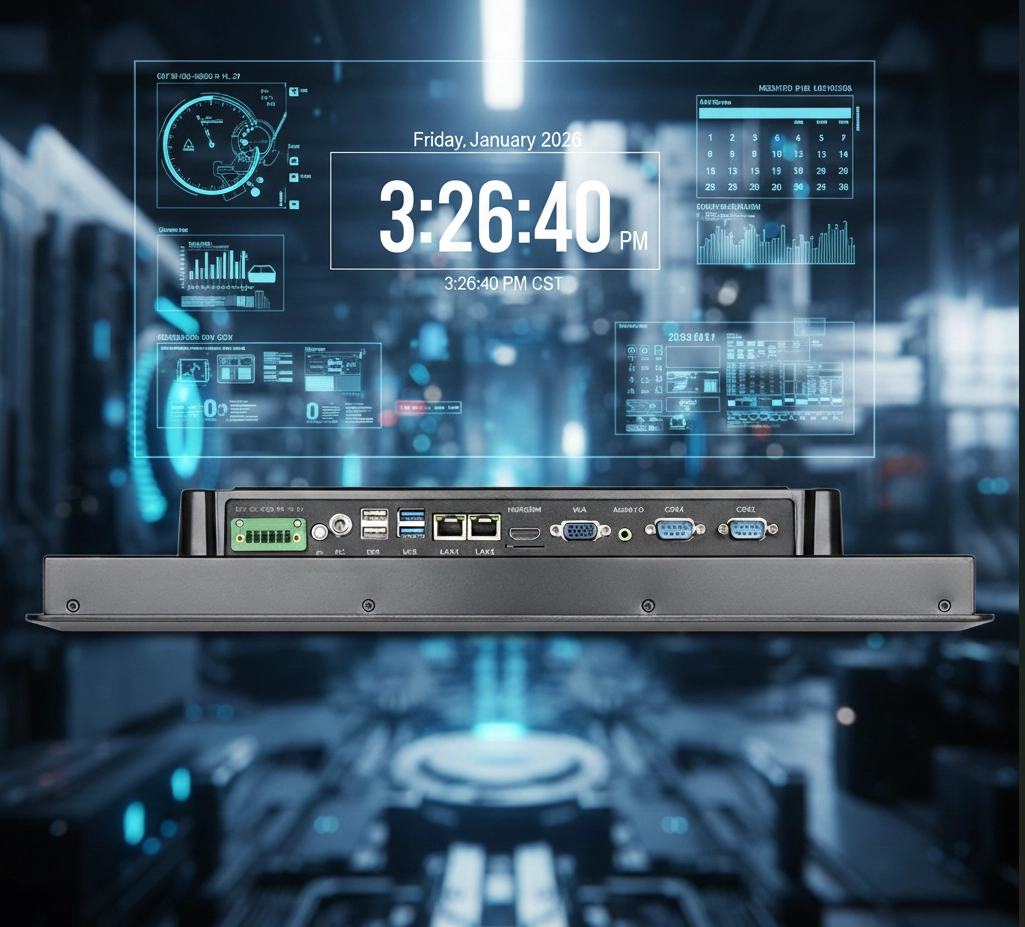
Modern IPCs utilize “Software-Defined” COM ports. This allows a single physical port to be toggled between RS-232, RS-422, or RS-485 via BIOS or software, eliminating the need to swap hardware modules. Furthermore, High-density GPIO (General Purpose Input/Output) allows the IPC to interface directly with switches and sensors, often replacing a small PLC in simpler applications.
Software-Hardware Integration: Driver Compatibility and SDKs
Hardware is only as good as its software stack. A professional I/O design includes:
- Long-Term OS Support: Drivers that are validated for Windows 10 IoT, Windows 11, and various Linux distributions (Ubuntu/Debian).
- Rich API Support: Providing SDKs for C++, C#, and Python allows software engineers to call I/O functions with minimal overhead, drastically reducing the development cycle.
Cost vs. Benefit: How I/O Design Optimizes Total Cost of Ownership (TCO)
Experienced procurement managers know that the “sticker price” is only the tip of the iceberg. The true cost of an IPC is found in its maintenance and the cost of lost production.
Reducing Mean Time to Repair (MTTR) via Design
When a production line stops, every second counts.
- Diagnostic LEDs: Dedicated status LEDs for each I/O port allow on-site technicians to instantly distinguish between a software glitch, a broken sensor, or a port failure.
- Fault Isolation: By isolating I/O channels, a short circuit in a single sensor won’t take down the entire system, allowing for localized repairs without full-scale shutdowns.
Long-term Supply Commitment and Industrial Consistency
Beyond Info System guarantees a supply lifecycle of 5 to 15 years. This ensures that when you expand your plant in three years, you can purchase the exact same hardware configuration, avoiding the astronomical costs of re-validating your software against new I/O drivers.
Industrial PC I/O Frequently Asked Questions (FAQ)
1. Why is “Galvanic Isolation” critical for my factory I/O?
Answer: In industrial settings, large equipment creates “Ground Loops” and voltage spikes. Galvanic isolation uses light (optocouplers) to transfer data, preventing these spikes from physically entering the sensitive CPU circuitry. It is the single most important insurance policy for system uptime.
2. How do I choose between Front-side and Top-side I/O?
Answer: This depends entirely on your enclosure. For shallow cabinets, “Front-side I/O” allows for easy access and cable routing. For DIN-rail mounting where space is vertically constrained, “Top-side I/O” is often the preferred choice to keep the footprint slim.
3. Is USB 3.0 reliable enough for industrial applications?
Answer: Only if it is “Industrial-Grade.” Standard USB connectors are prone to vibration and noise. Industrial USB ports feature screw-locking mechanisms and enhanced EMI shielding to ensure high-speed data remains stable in high-interference environments.
Professional IPC Solutions: Beyond Info System
Choosing the right I/O configuration is a strategic decision. At Oltre il sistema informativo, we specialize in providing rugged, high-performance industrial computers tailored to the most demanding environments.
High-Performance I/O Configurations for Harsh Environments
Whether you are deploying machine vision systems requiring multiple PoE+ ports or energy monitoring systems needing isolated RS-485 communication, Beyond Info System has the expertise to configure the perfect hardware for your project.
Recommended Products and Technical Support
Our commitment goes beyond the sale. We offer:
- Custom I/O Configuration: Tailored connector types and protection levels.
- Long-Term Availability: Ensuring your project remains supported for years to come.