The landscape of modern industrial automation demands an uncompromising convergence of computing power, structural resilience, and absolute hygiene. As smart manufacturing, edge computing, and real-time data analytics expand across processing floors, the hardware tasked with running human-machine interfaces (HMIs) and supervisory control and data acquisition (SCADA) systems must endure increasingly hostile environments. Traditional commercial-grade or even standard aluminum industrial computers frequently fail when exposed to corrosive chemicals, high-pressure washdowns, and ambient dust.
To overcome these environmental vulnerabilities, industrial engineers and procurement managers consistently turn to stainless steel panel PCs. Designed to bridge the gap between heavy-duty computation and extreme physical durability, these specialized systems offer an impervious barrier against external contaminants. However, choosing the optimal hardware configuration requires a deep, technical dive into hardware architectures, ingress protection ratings, thermal dissipation mechanics, and long-term financial viability.
When evaluating new hardware deployments, decision-makers face a dual challenge: they must select a system capable of managing intense computational workloads while simultaneously projecting the total cost of ownership (TCO). This technical guide examines how advanced engineering justifies the initial asset cost of high-performance industrial embedded PCs, and outlines the path to a seamless, custom configuration for your production floor.
The Evolution of Industrial Automation and Stainless Steel PCs
The operational requirements of modern production facilities have shifted dramatically over the past decade. Driven by strict regulatory frameworks—such as the FDA (Food and Drug Administration) regulations in the United States, EHEDG (European Hygienic Engineering & Design Group) standards in Europe, and global HACCP (Hazard Analysis Critical Control Point) compliance—the emphasis on sanitation and equipment durability has reached an all-time high.
In industries such as food and beverage processing, pharmaceutical manufacturing, chemical synthesis, and marine operations, the environment itself acts as a constant threat to computing infrastructure. Standard industrial PCs built from aluminum or painted steel are highly susceptible to corrosion, chemical pitting, and paint flaking when subjected to daily sanitization routines.
This is where stainless steel panel PCs become an operational necessity. Utilizing high-grade alloys, typically SUS304 or SUS316L, these machines possess a natural resistance to oxidation and aggressive chemical agents:
- SUS304 Stainless Steel: Contains chromium and nickel, providing excellent corrosion resistance and mechanical durability for standard industrial processing and regular water washdowns.
- SUS316L Stainless Steel: Features an addition of molybdenum and lower carbon content, significantly enhancing its resistance to chlorides, marine salt spray, and highly acidic or alkaline sanitizing agents used in deep-cleaning cycles.
The structural integrity of a stainless steel enclosure prevents microscopic pitting—a phenomenon where bacteria or chemical residues become trapped in minute surface imperfections. By eliminating these microscopic biological harbors, stainless steel panel PCs ensure that the compute node itself satisfies the most stringent cleanroom and hygienic processing requirements. Investing in a stainless steel chassis is not merely about protecting the internal motherboard; it is a fundamental strategy to eliminate batch contamination risks, prevent unscheduled line stoppages, and ensure continuous operation across multi-shift production cycles.
Why Fanless Architecture Matters in Harsh Environments
The presence of a cooling fan is one of the most common single points of failure in an industrial computing environment. In a standard computer, mechanical fans draw ambient air into the chassis to cool internal components like the central processing unit (CPU) and voltage regulator modules (VRMs). However, in harsh industrial environments, this ambient air carries atomized moisture, airborne dust, conductive metallic filings, grease, and biological contaminants.
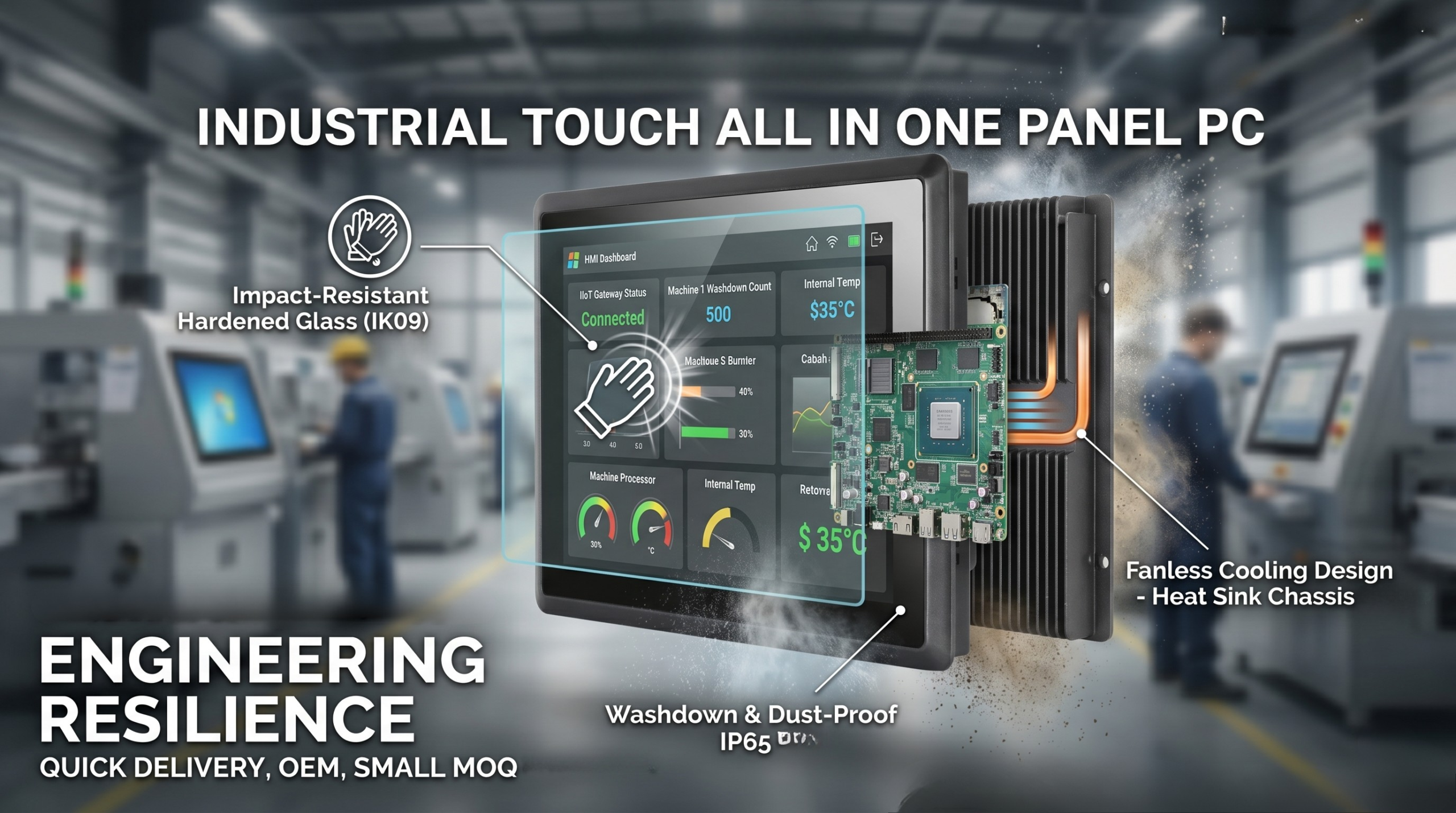
Fanless architecture eliminates this vulnerability entirely by transitioning from active convective cooling to passive conductive and radiant cooling. In a fanless stainless steel panel PC, the internal thermal design is engineered to transfer heat directly away from the CPU via specialized copper heat pipes and thermal pads to the heavy-gauge stainless steel rear chassis, which acts as a massive heat sink.
- Eradication of Internal Contaminants: Because the chassis requires no ventilation slots, air intake ports, or exhaust grills, the internal components remain completely isolated. Moisture cannot condense on internal circuit boards, and conductive dust cannot accumulate to cause short circuits.
- Mechanical Reliability: Fans are mechanical devices with a defined Mean Time Between Failures (MTBF). Bearings dry out, blades warp under high ambient heat, and sticky airborne residues can seize the motor completely. Eliminating the fan dramatically extends the overall system MTBF, reducing maintenance overhead.
- Shock and Vibration Resistance: By pairing a fanless thermal design with Solid State Drives (SSDs) rather than mechanical Hard Disk Drives (HDDs), the entire panel PC becomes highly resilient against continuous structural vibrations and sudden mechanical shocks common on heavy machinery lines.
The architectural decision to deploy fanless systems directly drives down operational expenditure. It protects the core computing engine from the invisible threats of the factory floor, ensuring that high-performance compute nodes remain fully operational over long lifecycles without human intervention.
Spec Sheet Face-Off: Key Parameters to Compare
To successfully compare fanless stainless steel panel PC specifications, system architects must look beyond superficial marketing descriptions and dissect the precise technical parameters detailed on the manufacturer’s data sheet. A miscalculation in any of these core specifications can result in system failure, regulatory non-compliance, or a bottleneck in industrial throughput.
Ingress Protection (IP) Ratings: IP65 vs. IP66 vs. IP69K
The Ingress Protection rating defines exactly how effectively an electrical enclosure prevents the entry of foreign solids and liquids. When evaluating stainless steel PCs, understanding the nuances between these ratings is critical:
| Indice IP | Solid Protection | Liquid Protection | Cleaning Method Suitability |
IP65 | Dust-tight; full protection against contact. | Protected against low-pressure water jets from any angle. | Light wiping, gentle spraying; no high-pressure exposure. |
IP66 | Dust-tight; full protection against contact. | Protected against high-pressure, heavy water jets (e.g., rough seas or intense washdowns). | Standard industrial washdowns with hoses, without specialized high-temp equipment. |
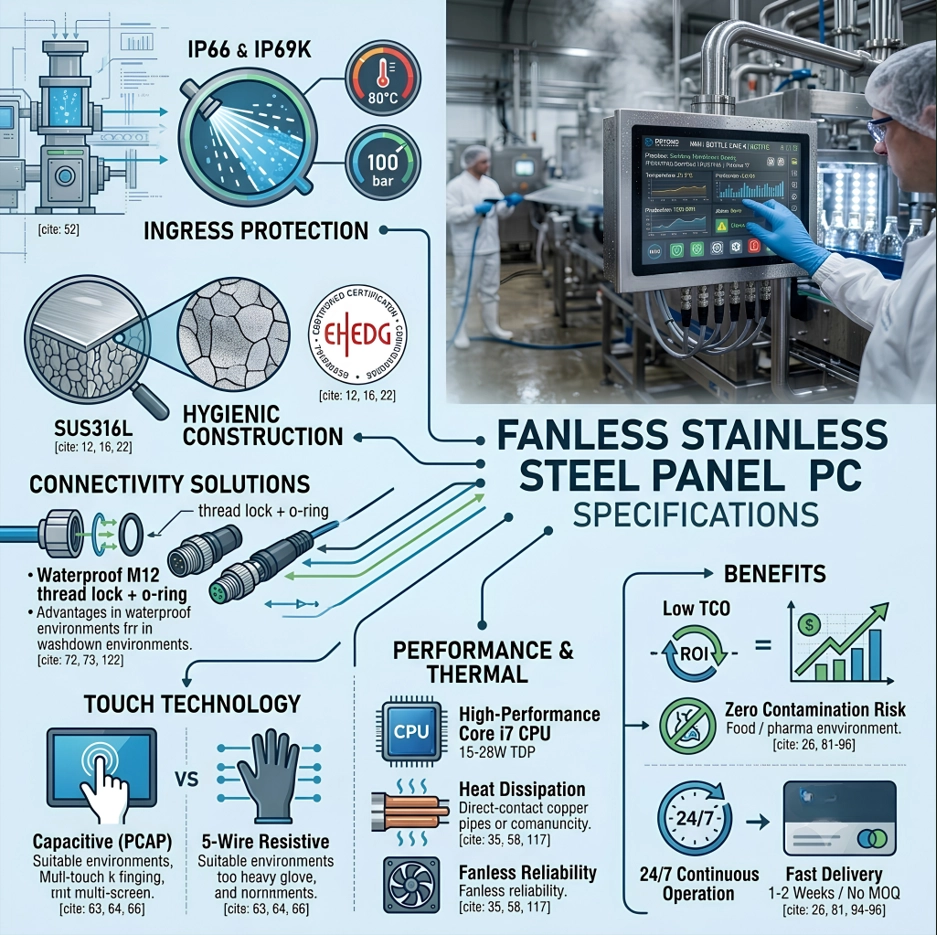
IP69K | Dust-tight; full protection against contact. | Protected against close-range, high-pressure, high-temperature washdowns (80°C water at 100 bar pressure). | Intensive sanitary sanitation cycles using chemical agents and steam/high-temp pressure washers. |
Furthermore, buyers must verify whether the rating applies only to the Front Bezel (suitable for flush panel mounting where the rear is protected inside a sealed electrical cabinet) or if the system offers Full 360-Degree IP66/IP69K Protection (necessary for standalone yoke, arm, or VESA mounting directly on the production floor).
Processor & Performance Balancing
A common misconception is that fanless systems are limited to low-power, sluggish processors. While energy-efficient platforms like the Intel Atom®, Celeron®, or Intel® Core™ i3 are exceptional for dedicated, single-purpose HMI screens, modern industrial automation often requires much higher throughput.
Engineers looking at the true performance parameters must evaluate the Thermal Design Power (TDP) of the processor. Advanced fanless panel PCs can now comfortably dissipate heat from high-performance CPUs, such as the Intel® Core™ i5 and i7 mobile or embedded series, configured with optimized thermal profiles (typically between 15W and 28W TDP). This allows the system to effortlessly manage intensive concurrent workloads, including local edge AI vision inspection, high-frequency data logging, multi-axis motion control orchestration, and complex SCADA graphics generation, all without exceeding safe thermal thresholds.
Touchscreen Technology: PCAP vs. 5-Wire Resistive
The choice of touch technology directly determines how operators interface with the automation loop under real-world conditions:
- Projective Capacitive (PCAP): Offers a multi-touch, highly intuitive user experience protected by a scratch-resistant, hardened glass surface. To excel in industrial settings, PCAP screens must feature specialized controller firmware that ignores false touches caused by water droplets, condensation, or trailing fluid streaks during operation.
- 5-Wire Resistive: Functions via physical pressure rather than electrical capacitance. This makes resistive screens highly dependable in heavy industrial zones where operators must wear thick insulated gloves, leather welding gear, or rubber safety wear. The 5-wire variant provides significantly higher durability and point-accuracy over older 4-wire layouts.
Connectivity and Industrial I/O Mechanics
Standard I/O ports like standard USB-A, RJ45 Ethernet, or HDMI connections are inherently weak links in a washdown environment because moisture can ingress through small gaps. To maintain a true IP66 or IP69K seal across the entire compute node, premium stainless steel panel PCs utilize specialized waterproof M12 connectors.
M12 connectors feature a rugged, threaded, circular metal locking mechanism equipped with internal O-ring seals. When paired with mating M12 cables, these connections form an impenetrable, hermetic barrier against liquids and dust. When specifying a system, ensure you calculate the exact number of serial connections (RS-232/422/485 for legacy PLC integration), isolated LAN ports (to separate factory-floor OT networks from corporate IT infrastructure), and digital I/O lines required for direct sensor interaction.
Configuring Your Solution: Overcoming Sourcing Friction
Selecting the right hardware specifications is only one half of a successful deployment strategy; the other half lies in execution, deployment integration, and calculating your capital outlay. When exploring the cost of high-performance industrial embedded PCs, procurement teams must look past the initial acquisition price and analyze long-term operational efficiency.
High-performance embedded computing platforms require a larger upfront capital expenditure compared to commercial hardware, but their return on investment (ROI) is realized through the avoidance of systemic downtime. Consider the compounding financial impact of a single computer failure on an automated production line: Line Halts leading to immediate cessation of manufacturing throughput; Labor Loss while technical teams troubleshoot hardware; Scrapped Material from ruined perishable batches ; and emergency Replacement Costs. By matching exact environmental challenges with corresponding technical specifications—such as a fanless cooling architecture, a SUS316L chassis, specialized M12 connectivity, and high-performance embedded processing power—the frequency of these catastrophic failures drops to near zero.
To complement your panel PC deployments or to expand your automated architecture into areas where a fully integrated display is not required, deploying standalone rugged computing blocks is an ideal approach. For deep-tier automation control, localized machine vision processing, or serving as an independent IoT gateway, utilizing a robust, non-display solution is highly efficient. You can explore a highly reliable range of standalone industrial embedded box PCs to handle intensive background automation workloads seamlessly alongside your panel systems.
Traditional industrial hardware procurement cycles are frequently derailed by bloated lead times, excessive minimum order barriers, and uncertain quality validation. As a trusted partner for automation engineers, system integrators, and OEMs, Au-delà du système d'information addresses these direct pain points by offering a streamlined operational model tailored to your project demands:
- Fast Delivery (1-2 Weeks): Minimize project delays and engineering bottlenecks with rapid fulfillment timelines, ensuring your automated lines go live on schedule.
- Small MOQ (Minimum Order Quantity): Maintain complete financial flexibility. Whether you require a single unit for a specialized prototype evaluation or a localized pilot run, you can scale your orders naturally without artificial purchasing barriers.
- 100% Assurance qualité : Every individual system undergoes rigorous thermal stress screening, component-level inspection, vibration resilience testing, and ingress sealing verification to ensure flawless out-of-the-box reliability.
Configuring your industrial automation layout should never involve settling for generic, off-the-shelf compromises. By meticulously analyzing your operational environment, contrasting core spec sheets, and leveraging agile, high-reliability manufacturing support, you can build a resilient compute infrastructure designed to perform for years to come.
Are you ready to optimize your upcoming automation deployment, review specialized custom configurations, or request a technical quote tailored to your exact performance specifications? Please contact Au-delà du système d'information directly to connect with our application engineering team and secure the ideal computing foundation for your enterprise.
Foire aux questions (FAQ)
Q1: What is the difference between IP66 and IP69K stainless steel panel PCs?
- Réponse : The primary differences center on water pressure, water temperature, and proximity during cleaning cycles. Un IP66 rating guarantees that the computer enclosure is completely dust-tight and can withstand high-pressure, heavy water jets projected from any direction via a standard 12.5 mm nozzle. This is ideal for standard industrial environments that experience heavy washing or wet processing. Un IP69K rating represents the absolute highest level of liquid ingress protection available, specifying that the enclosure can withstand close-range, high-pressure, high-temperature washdowns. The testing parameters include a water temperature of 80°C, an intense fluid pressure ranging from 80 to 100 bar, and a nozzle held a mere 10 to 15 cm away from the chassis. This level of protection is mandatory for sanitary processing floors where equipment must be systematically sterilized with steam and aggressive chemical solutions.
Q2: Can fanless panel PCs handle high-performance automation tasks?
- Réponse : Yes, modern fanless industrial PCs are fully capable of executing demanding, high-throughput automation workloads. Historically, fanless systems were constrained to low-power processors due to early limitations in thermal engineering. However, advanced systems leverage sophisticated passive thermal dissipation techniques. By utilizing direct-contact pure copper heat pipes, high-conductivity thermal interface materials (TIMs), and thick, precision-milled aluminum or stainless steel external chassis walls, heat is efficiently pulled away from the silicon core. This engineering allows fanless PCs to run powerful multi-core processors—such as embedded Intel® Core™ i5 and i7 CPUs—within stable, safe thermal operating ranges. These configurations provide more than enough performance to run heavy local databases, real-time edge AI analytics, advanced machine vision inspection layers, and multi-threaded HMI/SCADA configurations simultaneously.
Q3: Why are M12 connectors preferred over standard ports in stainless steel PCs?
- Réponse : Standard connectivity interfaces (such as traditional RJ45 Ethernet jacks, USB Type-A ports, or D-Sub serial connectors) possess physical design elements that are fundamentally incompatible with wet, dusty, or hygienic environments. They rely on friction fits and leave open physical gaps around the receptacle pins, creating an immediate path for water ingress, capillary moisture tracking, and particulate accumulation. Connecteurs M12 utilize a rugged, circular, threaded metal locking collar that compresses an internal, industrial-grade rubber O-ring when screwed tightly into place. This mechanical connection provides a completely hermetic, dust-proof, and waterproof seal that maintains its rated IP integrity even when subjected to intense, high-pressure washdowns while cables are actively connected. Furthermore, M12 connectors are highly resistant to structural vibrations, preventing cables from working themselves loose over extended operation on heavy vibrating machinery.