In the rapidly evolving landscape of Industrial IoT (IIoT) and edge computing, the reliability of hardware is the cornerstone of operational success. Traditionally, computers relied on high-speed fans to dissipate heat—a mechanical vulnerability that often led to system failure in harsh environments. Enter the Fanless Industrial Computer. By eliminating moving parts and reimagining thermal management, these systems have become the gold standard for automation, transportation, and medical sectors.
What is a Fanless Industrial Computer? Core Technology and Principles
Thermal Design: From Active Fans to Passive Heat Sinks
The fundamental difference between a consumer PC and a fanless industrial PC lies in how they handle “waste heat.” Standard computers use Active Cooling, where fans pull in ambient air to cool the internal components. However, in an industrial setting, this air is often contaminated with dust, oil mist, or moisture.
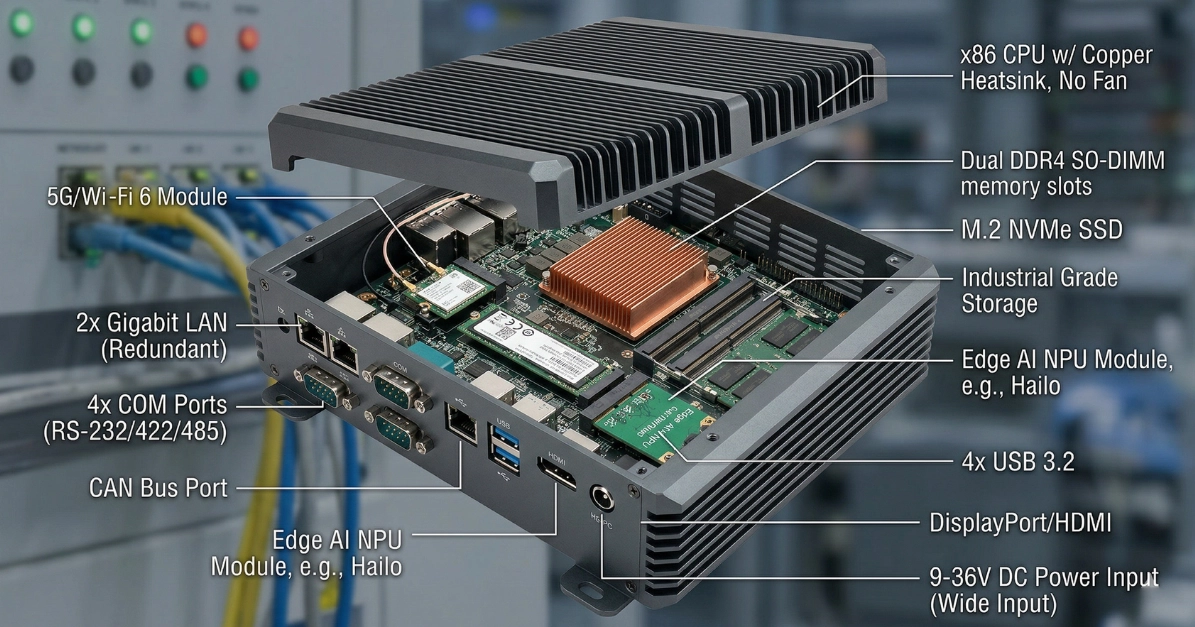
Passive Cooling replaces the fan with a sophisticated thermal conduction system. Heat generated by the CPU and other high-performance chipsets is transferred via high-conductivity materials—such as copper heat pipes or aluminum thermal blocks—directly to the outer chassis. The chassis itself, often designed with deep integrated fins, acts as a massive radiator, dissipating heat into the surrounding air through natural convection.
Total Enclosure: Protecting Internal Electronics
Because a fanless PC does not require air intake vents, the chassis can be Totally Enclosed. This “sealed” design creates a physical barrier against the environment. Beyond Info System designs these enclosures using heavy-duty extruded aluminum or stainless steel, ensuring that sensitive internal electronics are isolated from external threats.
| Feature | Active Cooling (Fanned) | Passive Cooling (Fanless) |
| Cooling Mechanism | Mechanical Fan & Forced Airflow | Heat Sinks & Natural Convection |
| Failure Points | Fan Bearing Wear, Dust Clogging | None (No moving parts) |
| Acoustic Noise | 30–50 dB (Audible) | 0 dB (Totally Silent) |
| Ingress Protection | Low (Requires vents) | High (Can reach IP65/IP67) |
| Maintenance | Frequent (Filter/Fan cleaning) | Minimal to Zero |
Core Advantages: Why Your Industrial Environment Demands Fanless
Superior Dust and Vibration Resistance
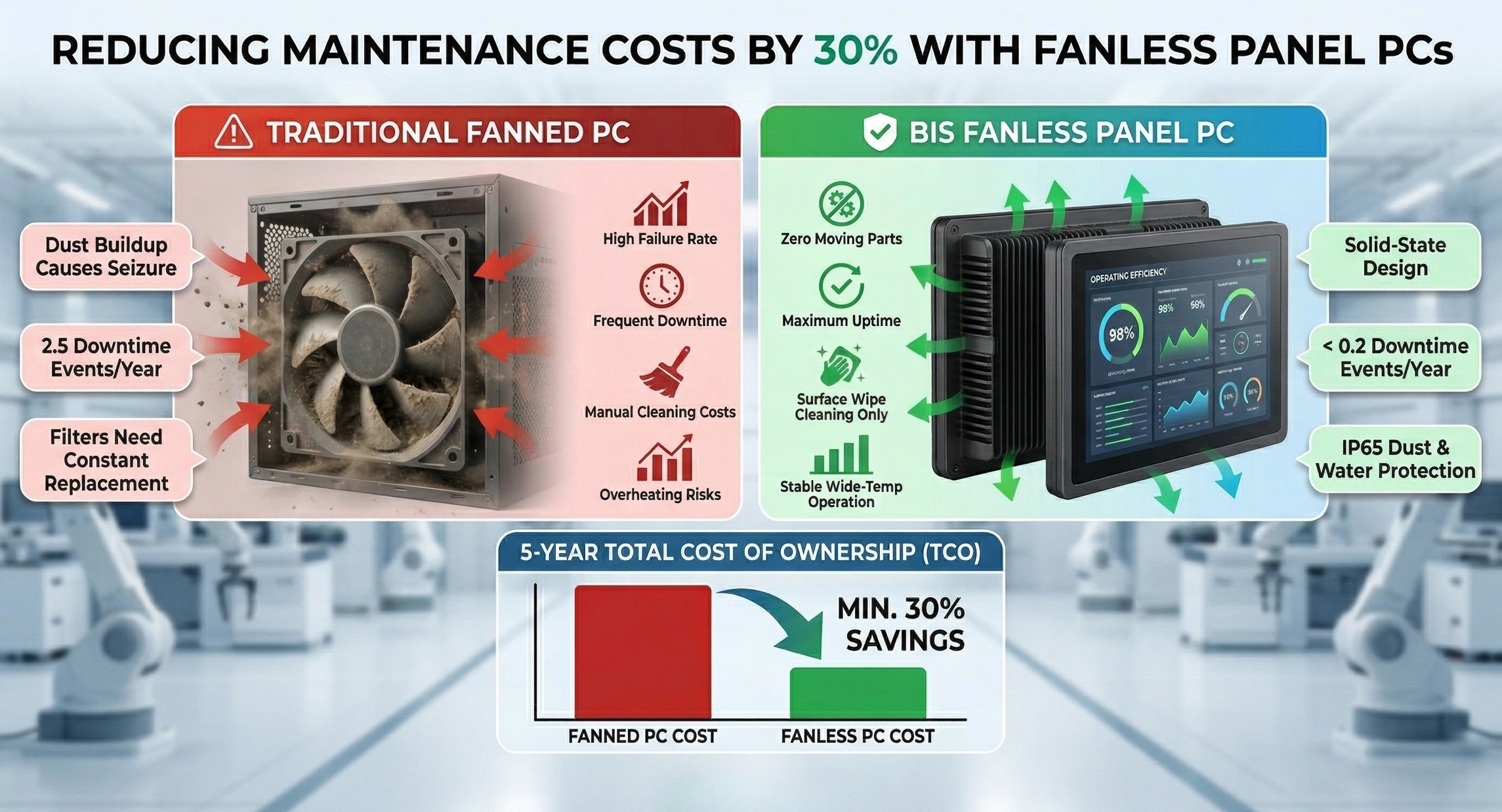
In industries like woodworking, textile manufacturing, or metal CNC machining, fine particles are ubiquitous. A fanned PC acts like a vacuum cleaner, sucking these particles inside until the system shorts out or the fan seizes. A fanless PC eliminates this risk entirely.
Furthermore, by removing the fan and often utilizing “cable-less” internal designs, these computers are significantly more resistant to Shock and Vibration. Whether mounted on a vibrating robotic arm or a moving forklift, the absence of mechanical wear parts ensures long-term structural integrity.
High Reliability and Lower Total Cost of Ownership (TCO)
While the initial purchase price of a fanless system might be higher than a commercial PC, the Total Cost of Ownership (TCO) is dramatically lower. System downtime in a factory can cost thousands of dollars per hour. By removing the #1 cause of hardware failure—the fan—companies reduce emergency repairs, spare parts inventory, and the labor costs associated with routine maintenance.
Wide Temperature Operation: From Arctic Cold to Furnace Heat
Fans are notorious for failing in extreme temperatures; lubricants can freeze in the cold or thin out in extreme heat. Fanless industrial computers are engineered with Industrial-Grade Components (capacitors, power chokes, and transistors) that are rated for “Wide Temperature” ranges, typically from -20°C to 70°C (-4°F to 158°F). This allows for stable deployment in outdoor kiosks, oil rigs, or cold storage warehouses.
Key Hardware Elements of Fanless Systems
The Balance of Low TDP Processors
To maintain a fanless profile, thermal efficiency is key. Engineers select CPUs with a low Thermal Design Power (TDP). Modern Intel® Atom™, Celeron®, and Core™ U-Series processors offer a “Sweet Spot” of high computational power with minimal heat output. This ensures the system can handle complex tasks—like real-time data analytics—without triggering “thermal throttling” (slowing down to cool off).
Integration of Industrial Storage and Anti-Vibration Components
A fanless system is only as strong as its weakest link. Therefore, traditional mechanical Hard Disk Drives (HDDs) are replaced by Solid State Drives (SSDs) or M.2 NVMe storage. Without spinning platters, the storage is immune to vibration. Additionally, many fanless PCs use Soldered RAM or specialized ruggedized connectors to ensure no components jiggle loose during operation.
Rich I/O Connectivity: The Gateway to Automation
A fanless PC often serves as a “Universal Translator” on the factory floor. Despite their compact size, they are packed with essential industrial interfaces:
- Legacy Serial Ports (RS-232/422/485): For connecting to older PLCs and sensors.
- Dual/Quad Gigabit LAN: Enabling network redundancy or connecting high-resolution PoE (Power over Ethernet) cameras for vision inspection.
- Isolated Digital I/O (DIO): To protect the motherboard from voltage spikes when controlling external relays or switches.
Global Industry Use Cases: Fanless PCs in Action
Smart Factories: Production Control and AI Vision
In the era of Industry 4.0, fanless PCs act as Edge Gateways. They sit directly on the assembly line, collecting data from various sensors and performing “Edge Analytics” before sending summarized data to the cloud. In Automated Optical Inspection (AOI), fanless systems with GPU acceleration scan products for defects at high speeds, providing a reliable, 24/7 quality control solution that never takes a break.
Intelligent Transportation: Outdoor Kiosks and In-Vehicle Computing
Public transport environments are brutal. Outdoor digital signage and ticketing kiosks face direct sunlight, humidity, and dust. A fanless PC’s sealed chassis protects it from these elements. In-vehicle applications (buses, trains, police cars) benefit from the E-Mark certified power designs of fanless PCs, which handle the unstable voltage of a vehicle’s ignition system while recording multi-channel surveillance footage.
Healthcare and Laboratories: Silence and Hygiene
In a surgical suite or a quiet laboratory, the hum of a computer fan can be a distraction or even a contamination risk (by circulating airborne pathogens). The 0 dB Silent Operation of fanless computers makes them ideal for medical carts and diagnostic equipment. Furthermore, their smooth, vent-less surfaces are easier to disinfect, supporting strict hygiene protocols.
How to Choose the Right Fanless Embedded System
Evaluating Installation Environment and Airflow
While “fanless” means no internal fan, the laws of physics still apply. The external heat sink needs a small amount of “breathing room.” When mounting a PC inside a sealed control cabinet, one must calculate the Thermal Budget. Will the heat from the PC raise the internal cabinet temperature too high? Choosing a PC with a high-surface-area fin design can mitigate these concerns.
Regulatory Compliance and Certifications
Depending on your region (e.g., the European Union) and industry, you may require specific certifications:
- CE/FCC: For electromagnetic interference.
- EN 50155: Specifically for railway applications.
- IEC 60601-1: For medical electrical equipment safety.
- IP65/66 Rating: If the unit will be exposed to direct water jets or heavy rain.
Frequently Asked Questions (FAQ)
- Q: Do fanless computers overheat and slow down (Throttling)?
- A: As long as the unit is operated within its specified temperature range and has adequate surrounding space for natural convection, it will maintain its rated clock speed without throttling. Quality fanless designs account for “Worst Case Scenarios” to ensure 100% CPU load stability.
- Q: Does dust buildup on the external fins affect performance?
- A: Unlike fanned PCs where dust kills internal components, dust on external fins only slightly reduces heat exchange efficiency. A simple wipe or a blast of compressed air on the exterior is all the maintenance required—no need to open the chassis.
- Q: Can a fanless PC support high-end AI or Graphics?
- A: Yes. Modern fanless designs can incorporate low-power AI accelerators (like Intel® Movidius or NVIDIA® Jetson modules) or specialized MXM GPU modules within “Ruggedized” fanless enclosures that utilize advanced thermal pipe technology.
Beyond Info System: Your Industrial Computing Partner
Company Overview: Professional OEM/ODM Solutions
Beyond Info System is a premier provider of industrial computing solutions, dedicated to engineering high-performance hardware for the most demanding environments. We specialize in serving the European and global markets with OEM/ODM services, offering long-life cycle support (5–7 years) and deep customization to meet the specific mechanical and electronic needs of our clients.
Recommended Products from Beyond Info System
Industrial Panel PCs: Our flagship line combines vibrant, high-contrast displays with rugged fanless internals. Featuring IP65-rated front bezels, these are perfect for HMI (Human Machine Interface) applications in food processing and factory automation.
Fanless Embedded Box PCs: Ultra-compact yet powerful, these units are designed to be tucked away in tight spaces. With various mounting options (DIN-rail, Wall mount, VESA), they provide the flexibility needed for modern IIoT deployments.
Rugged Solutions: For clients requiring the highest level of durability, our rugged series offers enhanced wide-temperature support and shock resistance, ensuring mission-critical reliability where others fail.
Contact us to explore our full range of solutions.