Modern field workers, technicians, and warehouse staff increasingly rely on tablets as their main work tools, but consumer devices rarely survive harsh conditions for long. A Windows rugged tablet is designed from the ground up to handle dust, water, drops, and long shifts in demanding environments. This guide explains the key specifications, real‑world use cases, and a simple checklist to help you choose the right device for your operations.
Why consumer tablets fail in outdoor and industrial environments
Explain that consumer tablets are optimized for office or home use, not for dust, moisture, shocks, or extreme temperatures. Emphasize total cost of ownership and downtime when devices fail.
Sub-points to cover:
- Limited protection against dust, water, and impact.
- Screens that are unreadable in bright sunlight.
- Batteries that cannot last a full shift.
- Fragile housings and connectors that break under real field use.
Key specifications that define a Windows rugged tablet
MIL‑STD‑810H: military‑grade durability
Explain what MIL‑STD‑810H is in simple language: an environmental test standard originally developed for military equipment. A Windows rugged tablet that passes relevant MIL‑STD‑810H tests has been verified to withstand drops, shocks, vibration, and temperature extremes representative of real‑world usage.
Touch on:
- Typical drop tests (for example, drops from around 1.2 to 1.5 meters onto plywood over concrete).
- Vibration tests for vehicles, forklifts, or machinery.
- Temperature and humidity cycling.
IP rating: dust and water protection you can rely on
Explain that the IP rating includes two digits: the first for dust ingress, the second for water. For outdoor and industrial applications, an IP65 rating or higher is usually recommended.
Cover:
- Why dust ingress is dangerous for internal components and connectors.
- The difference between simple splashes and powerful water jets or immersion.
- Typical scenarios: heavy rain at a construction site, washing down equipment in a factory, or working near hoses and sprinklers.
Sunlight‑readable displays and glove‑friendly touch
Explain that most consumer tablets are designed for indoor use; their brightness and surface finish make them hard to read under bright sun or strong ambient light. A true rugged tablet offers a high‑brightness panel, often 700–1000 nits or more, combined with anti‑glare or anti‑reflective treatments.
Mention:
- Reduced reflections and improved contrast outdoors.
- Optical bonding as a technique to minimize internal reflections and improve durability.
- The importance of glove‑operable and wet‑touch‑capable touchscreens for workers wearing PPE.
Long‑life and hot‑swappable batteries for full‑shift work
Describe how field and shop‑floor personnel often work long shifts away from power outlets. High‑capacity batteries and optional extended packs help rugged tablets last a full day.
Explain:
- Hot‑swappable battery designs that allow workers to replace a depleted battery without shutting down the tablet.
- Benefits for uninterrupted workflows, such as continuous data logging, navigation, or HMI monitoring.
Connectivity and I/O: integrating with your existing systems
Show that rugged tablets serve as mobile endpoints within a larger system. Wireless connectivity such as Wi‑Fi, 4G/5G, GPS, and Bluetooth keeps teams connected in real time.
Discuss:
- How RS‑232/422/485 ports, Ethernet, USB, and other industrial interfaces help connect to machines, sensors, and legacy equipment.
- The advantage of Windows: compatibility with existing ERP, MES, WMS, SCADA, and other enterprise applications.
Ergonomics and accessories for real‑world workflows
Explain that a rugged design is not only about strength; it must also be practical to carry and use every day. Mention:
- Hand straps, shoulder straps, and carry handles.
- Vehicle docks, desk docks, wall mounts, and charging cradles.
- Rubberized corners, balanced weight, and non‑slip surfaces.
Where Windows rugged tablets deliver the most value
Warehousing and logistics
Warehouse and logistics operations depend on accurate, real‑time data. A Windows rugged tablet can act as a mobile terminal for inventory checks, picking, packing, and shipping tasks. Workers can scan barcodes, update stock levels, and receive optimized picking routes on the go, all through familiar Windows applications. Mounted in forklift or truck docks, the same device can support fleet management, route navigation, and electronic proof of delivery without being damaged by vibration, dust, or temperature changes.
Construction sites and engineering projects
On construction sites, supervisors and engineers must access drawings, BIM models, schedules, and inspection forms in conditions that are far from office‑friendly. A rugged tablet with a sunlight‑readable screen allows them to review large CAD drawings, capture photos, annotate defects, and synchronize reports from the field. Robust housings, MIL‑STD‑tested durability, and high IP ratings mean that drops, mud, and rain are part of the job—not a reason for device failure.
Manufacturing and smart factories
In manufacturing plants, Windows rugged tablets bridge the gap between production lines and enterprise systems. Operators can monitor machine status, log quality data, and access digital work instructions directly at the line. Industrial I/O ports and wireless networks connect tablets to PLCs, sensors, and back‑end MES or ERP systems. Rugged designs protect the tablets from oil, dust, vibration, and around‑the‑clock usage typical of modern factories.
Public safety and facility management
For public safety, security, and facility management teams, rugged tablets provide a reliable mobile command center. Officers can access incident information, maps, and communication tools while on the move, even in harsh weather conditions. Facility managers can use tablets to track maintenance tasks, capture photos, and update asset records during inspections. The combination of Windows compatibility and rugged hardware ensures that mission‑critical applications remain available wherever the job takes them.
A practical checklist for choosing your Windows rugged tablet
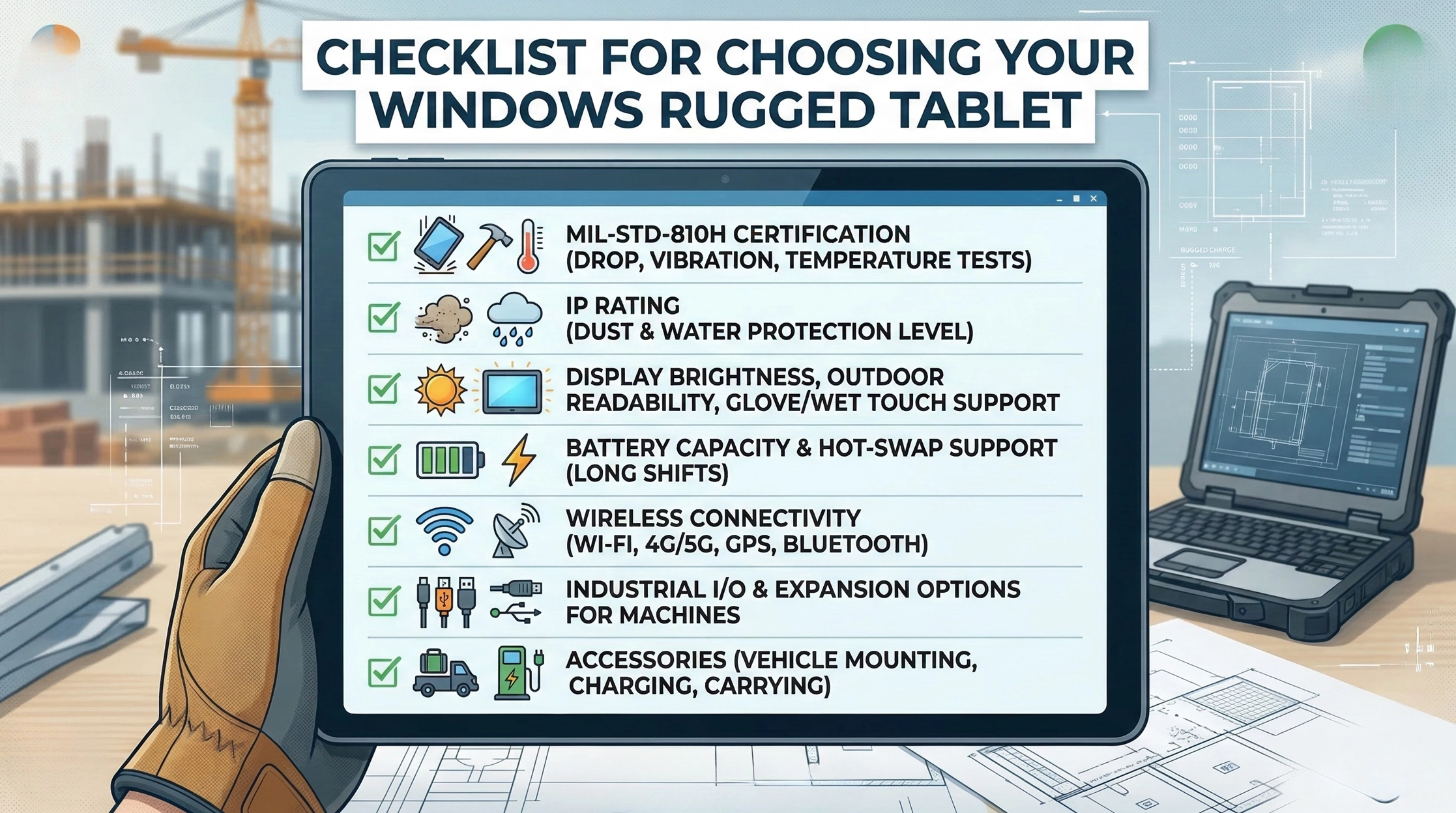
Create a clear, bullet‑style checklist summarizing all earlier points, for example:
- Required MIL‑STD‑810H tests (drop, vibration, temperature).
- Minimum IP rating for dust and water based on your environment.
- Display brightness and outdoor readability, plus glove/wet touch support.
- Battery capacity and whether hot‑swap is needed for long shifts.
- Wireless options: Wi‑Fi, 4G/5G, GPS, Bluetooth.
- Industrial I/O and expansion options for your machines and peripherals.
- Available accessories for vehicle mounting, charging, and everyday carrying.
Why partner with a specialized Windows rugged tablet vendor
Wrap up by positioning your company (without naming it here) as a solution provider:
- Experience with industrial Windows tablets and deployments across multiple industries.
- Ability to offer a broad product range and project‑based customization (I/O, mounting, OS image, etc.).
- Technical support, long‑term availability, and lifecycle management.
Looking for a reliable Windows rugged tablet solution for your industrial or outdoor application? Contact Beyond Info System and we will find the right device for your project.