Defining Your Application Requirements and Environment
In the realm of industrial computing, “one size fits all” is a myth that often leads to costly system failures. For OEM (Original Equipment Manufacturer) applications, the design process must begin with a rigorous assessment of the operational environment. Unlike commercial PCs sitting in climate-controlled offices, an Industrial PC (IPC) is often the “brain” inside a CNC machine, a roadside tolling system, or a maritime navigation console.
Assessing Environmental Stress Factors (Thermal, Dust, Vibration)
Before selecting a single component, you must quantify the physical stress the unit will endure.
- Thermal Extremes: Will the unit operate in a desert-based solar farm or a cold-storage warehouse? Standard components fail outside the 0 degree to +60 degree C range. Custom OEM designs often utilize wide-temperature components rated for -20 degree to +70 degree (or even -40 degree to +85 degree for military-grade applications).
- Ingress Protection (IP Rating): In food processing or outdoor signage, dust and moisture are lethal. Designing for IP65, IP66, or IP69K ensures the internal electronics remain hermetically sealed against high-pressure jets and fine particles.
- Shock and Vibration: For vehicle-mounted or factory-floor applications, constant micro-vibrations can loosen RAM sticks or damage traditional HDDs. Custom designs employ on-board soldered components and M12 connectors to maintain signal integrity under mechanical stress.
Performance vs. Power Consumption Balance
The “fastest” processor isn’t always the best for an OEM project. High-performance CPUs generate significant heat, which requires larger heatsinks or fans—elements that might not fit your enclosure.
- Edge Computing & AI: If your application involves real-time machine vision, you may require Intel® Core™ i7/i9 or even Xeon® processors paired with GPU accelerators.
- Low-Power Controllers: For simple HMI (Human Machine Interface) or data logging, Intel® Atom® or Celeron® processors offer the advantage of “TDP” (Thermal Design Power) as low as 6W-15W, enabling ultra-compact, fanless designs.
Form Factor and Mounting Constraints
Space is a premium in OEM machinery. The physical footprint dictates the motherboard selection (Mini-ITX, 3.5” Single Board Computer, or COM Express).
| Mounting Type | Typical Application | Key Advantage |
| Wall-mount | Factory side-panels | Easy access for maintenance |
| DIN-rail | Control cabinets / PLC integration | Standardized “clip-on” installation |
| Rackmount (1U-4U) | Server rooms / Data centers | High scalability and cable management |
| VESA Mount | Behind displays / HMI | Integrated, clean aesthetic |
Core Hardware Selection: Motherboards and Components
The internal architecture of your custom IPC defines its reliability. For OEMs, the priority shifts from “cutting-edge speed” to “longevity and stability.”
Industrial-Grade vs. Consumer-Grade Components
The most significant difference lies in the Bill of Materials (BOM) Control. While consumer motherboards change every 6-12 months, industrial motherboards offer a 7 to 15-year lifecycle. This prevents the “forced redesign” cycle, saving OEM customers millions in re-certification costs for medical or aerospace standards.
I/O Interface Customization (COM, LAN, GPIO)
OEM applications often require legacy support or specialized connectivity that standard PCs lack.
- Legacy Ports: RS-232/422/485 for communicating with older PLCs.
- Galvanic Isolation: Protecting the main system from electrical surges in industrial power grids via Isolated I/O.
- Power over Ethernet (PoE): Essential for deploying IP cameras or sensors without needing separate power cables.
Storage and Memory Reliability
In an industrial setting, data corruption is not an option.
- ECC Memory: Error Correcting Code RAM detects and fixes single-bit memory errors, preventing system crashes in mission-critical environments.
- Industrial SSDs: Utilizing 3D TLC or SLC-mode flash with “Power Loss Protection” (PLP) ensures that even during a sudden power outage, data currently being written is safely moved to the NAND flash.
Thermal Management and Mechanical Design
Heat is the primary enemy of electronic longevity. Effective thermal management in a custom IPC design is what separates a professional solution from a generic one.
Fanless vs. Active Cooling Solutions
At Beyond Info System, we champion Fanless Design whenever possible.
- The Problem with Fans: Fans are mechanical parts; they fail. They also act as vacuum cleaners, sucking in conductive dust and oil mist.
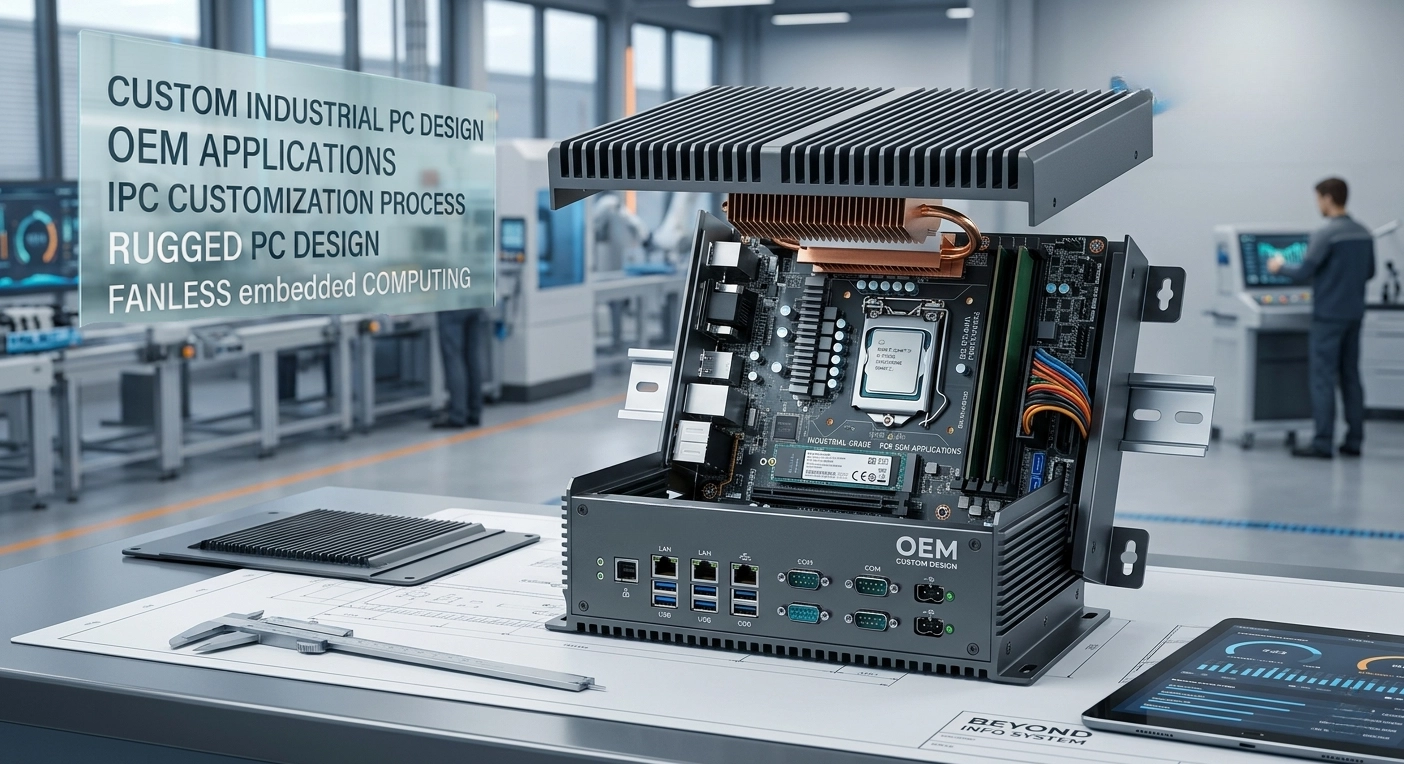
- The Solution: Using a passive cooling architecture where the aluminum chassis itself acts as a massive heatsink. Heat pipes transfer thermal energy from the CPU directly to the finned exterior of the case.
Rugged Enclosure Material and Shielding
The chassis must be more than a box. It must be an EMI (Electromagnetic Interference) shield. In high-voltage environments, such as power plants, the enclosure prevents external electrical noise from interfering with the internal circuitry, ensuring “Five Nines” (99.999%) uptime.
Software Integration and OS Customization
A custom IPC is only as stable as the software it runs. We specialize in tailoring the software stack to match the hardware’s rugged capabilities.
Embedded OS Optimization (Windows IoT, Linux)
Most OEM customers opt for Windows 10/11 IoT Enterprise LTSC.
- No Unwanted Updates: LTSC (Long-Term Servicing Channel) allows you to lock down the OS so it never performs an automatic update that could break your application.
- Footprint Reduction: We can strip away unnecessary Windows features (like the Xbox app or Cortana) to create a lean, fast-booting, and highly secure environment.
BIOS/Firmware Customization Services
We provide “White Label” BIOS services, including:
- Custom Boot Logo: Featuring your company’s branding.
- Watchdog Timer: A hardware-level monitor that automatically reboots the system if the application software freezes, ensuring the machine remains autonomous.
Compliance, Testing, and Quality Assurance
A custom design is a promise of performance. Validation is how we keep that promise.
Crucial Industrial Certifications (CE, FCC, RoHS)
Navigating global regulations is a core part of our expertise. Whether you are selling your OEM solution in Europe (CE), North America (FCC/UL), or China (CCC), we ensure the hardware meets all safety and emission standards.
Burn-in Testing and Validation Procedures
Every single unit manufactured by Beyond Info System undergoes a “Trial by Fire.”
- 100% Load Burn-in: Running the CPU and GPU at 100% capacity for 8 hours before shipment.
- Power Cycling: Rapidly turning the system on and off to test the durability of the power supply unit (PSU).
- Drop and Vibration Tests: Simulating the rigors of shipping and industrial operation.
Frequently Asked Questions (FAQ) for Custom IPC
Q1: What is the typical lead time for a custom OEM PC?
For a standard customization (I/O changes, branding), a prototype can be delivered in 4 to 6 weeks. For a full “ground-up” mechanical and PCB design, the timeline typically ranges from 3 to 6 months, depending on complexity and certification requirements.
Q2: How do you handle component EOL (End of Life)?
We provide a Product Longevity Roadmap. When a key component (like a chipset) is scheduled for EOL by the manufacturer, we notify our OEM partners at least 12 months in advance and offer “Last Time Buy” (LTB) options or seamless migration paths to the next generation.
Q3: Can I customize the chassis color and branding?
Absolutely. We offer full industrial design services, including powder coating in any RAL color, silk-screening your logo, and custom-designed I/O faceplates to match your machine’s aesthetic.
Beyond Info System: Your Trusted Partner for Industrial Computing
Choosing a partner for your OEM computing needs is a decision that impacts your product’s reputation for years to come. Beyond Info System (BIS) is not just a hardware vendor; we are a strategic engineering extension of your team.
Professional OEM/ODM Services and Expertise
With over 15 years of deep-rooted experience in industrial pc, Industrial Automation, and Rugged Computing, BIS understands the nuances of global supply chains and technical SEO-driven product management. We bridge the gap between complex engineering and market-ready solutions.
Featured Solutions: Rugged Panel PCs and Embedded Systems
Explore our diverse portfolio at www.beyondinfosys.com, featuring:
- Fanless Embedded PCs: High-performance, vibration-resistant cores for automation.
- Industrial Touch Panel PCs: Sunlight-readable, waterproof displays for outdoor or hygienic environments.
- Custom Industrial Touch Screen: Tailored layouts for specific spatial requirements.